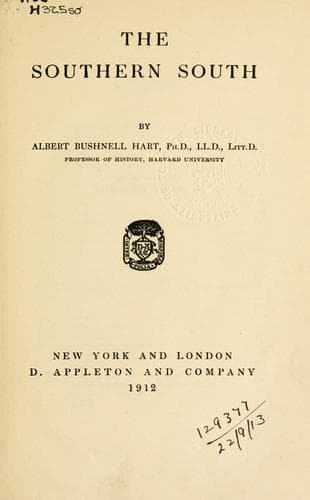
Southern States -- Social conditions; United States -- Race relations
By the series of constitutional amendments begun in 1890, and since spread
through the South, a property or intelligence qualification has
practically been established for Negroes while not applying to poor or
illiterate Whites. In the Northern states race difficulties, so far as
they take form in politics, are settled by the usual course of elections;
in the South it is the unalterable intention of the Whites that the
Negroes shall not participate in choosing officials or in making laws
either for white men or for themselves.
Furthermore, the South is bitterly opposed to the holding of offices by
Negroes except the small local appointments. Though Negroes are one third
in number in the South, and more than one half the population in two
states, they have not a single state administrative official, member of
legislature, or judge. The opposition to negro office holding extends to
federal appointments, although a considerable number of places, some of
them important, are still held by Negroes. They obtain appointments as
railway mail clerks and letter carriers by competitive examination, and a
few of them are selected for collectorships of internal revenue and of
customs, on the basis that the Negroes are part of the community and
entitled to some recognition. To exclude them altogether from the public
service, as they have been almost excluded from the suffrage, may somewhat
diminish race friction, but it is a mark of inferiority which the whole
negro race resents.
CHAPTER XXVII
MORAL REMEDIES
The regeneration of a race, as of mankind, is something that must proceed
from within and work outward. Hence the most obvious remedy for race
troubles is that both races should come up to a higher plane of living.
What has been the progress of the Negro in that direction; what is the
likelihood of further advance? The chance of the blacks is less than it
would be if the white race had a larger part in it. The Negro is
insensibly affected by the spirit of the community in which he lives. He
knows that though ruffians threaten him with revolvers or with malignant
looks that have a longer range, there are also broad-minded and
large-hearted white men who bid him rise; but he is almost cut off from
the machinery of civilization set in motion by his white neighbor; he
cannot use or draw books from the public library; he practically cannot
attend any churches, lectures, or concerts, except those provided directly
for him. On the plantation he hardly sees a white face, except those of
the managers and their families. He has little opportunity to talk with
white men; none for that interchange of thought which is so much promoted
by sitting round the same table. He can attend no colleges or schools with
white students. In the common schools and in many institutions above, he
meets only negro teachers. He is far more cut off from the personal touch
and influence of white men and women of high quality than he was in
slavery times.
Public-domain text, read in full here on John Shaqi.
Reviews
Reviews
No reviews yet
Be the first to share your thoughts on this work.
Elsewhere in the archive
Join the Discussion
Join the discussion
Sign in to leave a comment or review.
Sign InorCreate an account