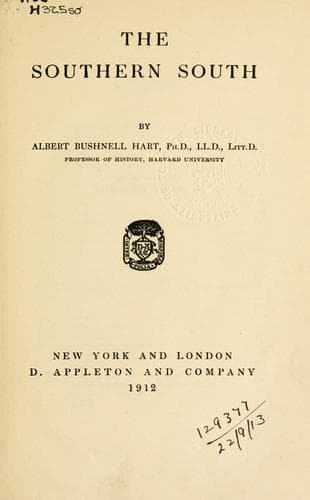
Southern States -- Social conditions; United States -- Race relations
The Mountain Whites ought not to be confused with the Poor Whites of the
lowlands. Although there are many similarities of origin and life, the
main difference is that the mountaineers have almost no Negroes among them
and are therefore nearly free from the difficulties of the race problem.
In the lowlands as in the mountains, men whose fathers had settled on rich
lands, as the country developed were unable to compete with their more
alert and successful neighbors, who were always ready to outbid them for
land or slaves; therefore they sold out and moved back into the poor lands
in the lowlands, or into the belt of thin soil lying between the Piedmont
and the low country. Hence the contemptuous names applied to them by the
planting class--"Tar Heels" in North Carolina; "Sand Hillers" in South
Carolina; "Crackers" in Georgia; "Clay Eaters" in Alabama; "Red Necks" in
Arkansas; "Hill Billies" in Mississippi; and "Mean Whites," "White Trash,"
and "No 'Count" everywhere.
These so-called Poor Whites are to be found in every state in the South.
They are the most numerous element in the Southern population. They are
the people who are brought into the closest personal relations with the
Negroes. A survey of their conditions and prospects is therefore essential
for any clear understanding of the race question.
The present dominant position of the Poor Whites is different from that of
their predecessors in slavery times. Distant from the highways of trade,
having no crop which they could exchange for store goods, satisfied with
primitive conditions from which almost none of them emerged, the Poor
Whites then simply vegetated. With them the negro question was not
pressing, for they had little personal relation with the rich planters,
even when they lived in their neighborhood; and the free Negroes who were
crowded back like themselves on poor lands were too few and too feeble to
arouse animosity. Mountain people have little prejudice against Negroes:
but in the hills and lowlands, where the two races live side by side,
where the free black was little poorer than his white neighbor, the slave
on a notable plantation felt himself quite superior to the Poor Whites,
who in turn furnished most of the overseer class, and had their own
opportunities of teaching how much better any white man was than any
nigger.
Public-domain text, read in full here on John Shaqi.
Reviews
Reviews
No reviews yet
Be the first to share your thoughts on this work.
Join the Discussion
Join the discussion
Sign in to leave a comment or review.
Sign InorCreate an account