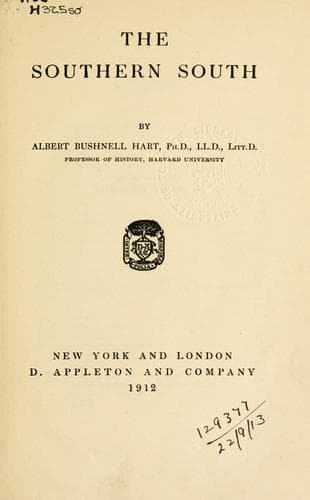
Southern States -- Social conditions; United States -- Race relations
Unlike the North, which ever since the Civil War has felt disposed to
consider itself the characteristic United States, the South looks upon
itself, and is looked upon by its neighbors, as a unit within a larger
unit; as set apart by its traditions, its history, and its commercial
interests. The ex-president of the Southern Confederacy a few years ago at
a public meeting declared that he appeared "In a defense of our
Southland." A Southland there is, in the sense of a body of states which,
while now yielding to none in loyalty to the Union and in participation in
its great career, adhere together with such a sense of peculiar life and
standards as is not to be found in any group of Northern communities
except perhaps New England.
The Northerner who addresses himself to these special conditions of the
South must expect to be asked what claim he has to form or express a
judgment upon his neighbors. The son of an Ohio abolitionist, accustomed
from childhood to hear questions of slavery and of nationality discussed,
I have for many years sought and accepted opportunities to learn something
of these great problems at first hand. As a teacher I have come into
contact with some of the brightest spirits of the South, and among former
students count at least two of the foremost writers upon the subject--one
a White and the other a Negro. For some years I have carried on an active
correspondence with Southern people of every variety of sentiment. I have
diligently read Southern newspapers and have been honored by their
critical and sometimes unflattering attention. In the last twenty-five
years I have made a dozen or more visits to various parts of the South
ranging in length from a few days to four months, and therein have gained
some personal acquaintance with the conditions of all the former
slave-holding states except Missouri and Florida. In the winter of 1907-8
I took a journey of about a thousand miles through rural parts of the belt
of states from Texas to North Carolina, with the special purpose of coming
into closer personal touch with some phases of the problem upon which
information was lacking.
There need be no illusions as to the extent of the knowledge thus
acquired. These various journeys and points of contact with Southern
people have shown how large is the Southern problem, and how hard it is to
discover all the factors which make the problem difficult. Every year
opens out some new unexplored field which must be taken into account if
one is to hope for anything like a comprehensive view of the subject. How
shall any Northerner coming into a slave-holding region set his
impressions alongside the experience of men who have lived all their lives
in that environment? What is seven months' residence by a visitor, a fly
on the wheel, against seventy years' residence by men who are a part of
the problem?
Public-domain text, read in full here on John Shaqi.
Reviews
Reviews
No reviews yet
Be the first to share your thoughts on this work.
Join the Discussion
Join the discussion
Sign in to leave a comment or review.
Sign InorCreate an account