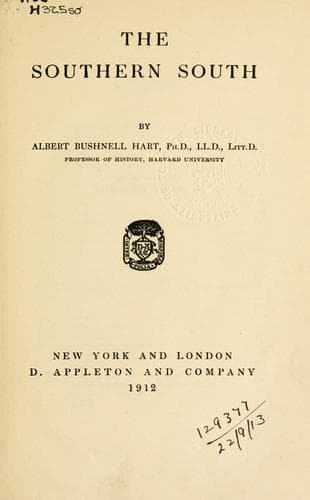
Southern States -- Social conditions; United States -- Race relations
In every other section of the United States the element of the population
descended from English colonists is flanked by, and in some places
submerged by, a body of European immigrants; and every state is penetrated
by great numbers of people from other states. Considering that the South
has contributed to other sections of the Union about two and a half
millions of people, the return current from the North has been
comparatively small. "Why is it," asks the Louisville _Courier Journal_,
"that so few of these home-seekers come South where the lands are cheaper
and better, where the climate is more congenial, and where it is much
easier to live and become independent from the soil?" Among the
inhabitants of the Southern States were enumerated in 1900 only 400,000
people born in the North, of whom 250,000 originated in the Northeastern
states from Maine to Pennsylvania, and 150,000 came from the Middle
Western group extending from Ohio to Kansas; but this 400,000 people are
so widely scattered that outside of Texas and Florida there are few groups
of Northern people. Some farmers are said to be coming from the
Northwestern states into tide-water Virginia; others to Baldwin County, in
southern Alabama; others to northern Mississippi; and to Lake Charles,
Louisiana; chiefly with a view to the trucking industry. Two or three
communities made up wholly of Northern people can be mentioned, such as
Thorsby in Alabama and Fitzgerald in Georgia, which last is apparently the
only flourishing experiment of the kind.
Of the 400,000 Northerners in the South the greater number are in the
cities and manufacturing towns, as business men, bosses and skilled
laborers in the mills, in professions and mechanical trades. As a rule
they do not adhere to each other, and many of them seem to wish to hide
their origin. Why is it that there is a flourishing Southern Club in New
York, and smaller ones in other cities, yet no Northern club anywhere in
the South? The Southern explanation is that the Northerner who settles in
the South, within a few weeks discovers that the convictions of a lifetime
on all Southern questions are without foundation; and he takes on the
color of the soil upon which he lives. If it be true that the Southern man
and woman in the North continues to feel himself Southern to the end of
his days, while the Northern man in the South tries to identify himself
completely with the community in which he means to stay permanently,
perhaps there is some explanation other than the impregnability of the
Southern position.
Public-domain text, read in full here on John Shaqi.
Reviews
Reviews
No reviews yet
Be the first to share your thoughts on this work.
Join the Discussion
Join the discussion
Sign in to leave a comment or review.
Sign InorCreate an account