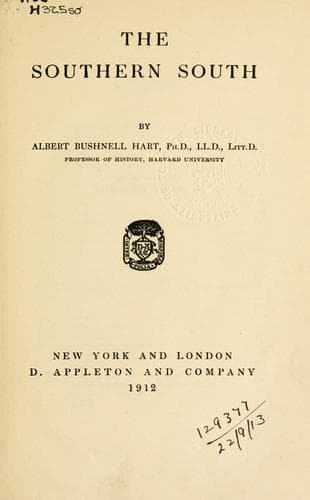
Southern States -- Social conditions; United States -- Race relations
It is not the same in the discussion of the race question. In half a dozen
instances in the last few years, attempts have been made to drive out
professors from Southern colleges and universities, on the ground that
they were not sufficiently Southern. In one such case, that of Professor
Bassett, at Trinity College, North Carolina, who said in print that Booker
Washington was the greatest man except Lee, born in the South in a hundred
years, it stood by him manfully, and his retention was felt to be a
triumph for free speech. Other boards of trustees have rallied in like
manner, and there is a fine spirit of fearless truth among professors of
colleges, ministers, lawyers, and public men. It is no small triumph for
the cause of fair play that John Sharp Williams, of Mississippi, in 1907
came out in opposition to Governor Vardaman's violent abuse of the Negro,
on that issue triumphed over him in the canvass for the United States
Senate; and then in a public address committed himself to a friendly and
hopeful policy toward the Negro.
In part, this frame of mind is due to a feeling neatly stated by a
Southern banker: "The Southern people are not a bad kind, and a kind word
goes a long way with them; they have odd peculiarities; they cannot argue,
and as soon as you differ with them, you arouse temper, not on the Negro
question especially, but on any." This diagnosis is confirmed by "Nicholas
Worth": "Few men cared what opinion you held about any subject.... I could
talk in private as I pleased with Colonel Stover himself about Jefferson
Davis or about educating the negro. He was tolerant of all private
opinions, privately expressed among men only. But the moment that an
objectionable opinion was publicly expressed, or expressed to women or to
negroes, that was another matter. Then it touched our sacred dead, our
hearthstones, etc." This state of feeling has much affected politics in
the South and is in part responsible for the phenomenon called the Solid
South, under which, whatever be its causes, the South is deprived of
influence either in nominating or supplying candidates for national
office, because its vote may be relied upon in any case for one party and
one only.
Public-domain text, read in full here on John Shaqi.
Reviews
Reviews
No reviews yet
Be the first to share your thoughts on this work.
Join the Discussion
Join the discussion
Sign in to leave a comment or review.
Sign InorCreate an account