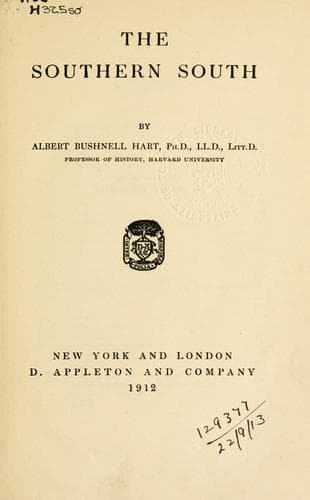
Southern States -- Social conditions; United States -- Race relations
The dislike of the critic is specially strong when criticism comes from
foreigners, and aggravated when it comes from Northerners. A recent
Southern speaker says: "Now, as since the day the first flagship was
legalized in its trade in Massachusetts, ... the trouble in the race
question is due to the persistent assertion on the part of northern
friends and philanthropists that they understand the problem and can
devise the means for its solution." That Northerners do not all lay claim
to such understanding, or hold themselves responsible for race troubles,
is admitted by a Southerner of much greater weight, Edgar Gardner Murphy,
who has recently said: "Beneath the North's serious and rightful sense of
obligation the South saw only an intolerant 'interference.' Beneath the
South's natural suspicion and solicitude the North saw only an
indiscriminating enmity to herself and to the negro."
To these characteristics another is added by "Nicholas Worth," in his
discussion of the "oratorical habit of mind" of a generation ago--"Rousing
speech was more to be desired than accuracy of statement. An exaggerated
manner and a tendency to sweeping generalizations were the results. You
can now trace this quality in the mind and in the speech of the great
majority of Southern men, especially men in public life. We call it the
undue development of their emotional nature. It is also the result of a
lack of any exact training,--of a system that was mediæval." Another form
of this habit of mind is the love of round numbers, a fondness for stating
a thing in the largest terms; thus the clever but no-wise distinguished
professor of Latin is "Probably the greatest classical scholar in the
United States," the siege of Vicksburg was "the most terrific contest in
the annals of warfare"; the material progress of the South is "the most
marvelous thing in human history."
This difference of temperament between North and South is not confined to
members of the white race. The mental processes of the Southern Negro
differ not only from those of the Southern White, but to a considerable
degree from those of the Northern Negro; and the African temperament has,
in the course of centuries, in some ways reacted upon the minds of the
associated white race. The real standards and aspirations of the Negroes
are crudely defined and little known outside themselves, and if they were
better understood they would still have scant influence upon the white
point of view. The "Southern temperament," therefore means the temperament
of the Southern Whites, of the people who control society, forum, and
legislature. It is always more important to know what people think than
what they do, and every phase of the race question in the South is
affected by the habits of thought of thinking white people.
Public-domain text, read in full here on John Shaqi.
Reviews
Reviews
No reviews yet
Be the first to share your thoughts on this work.
Join the Discussion
Join the discussion
Sign in to leave a comment or review.
Sign InorCreate an account