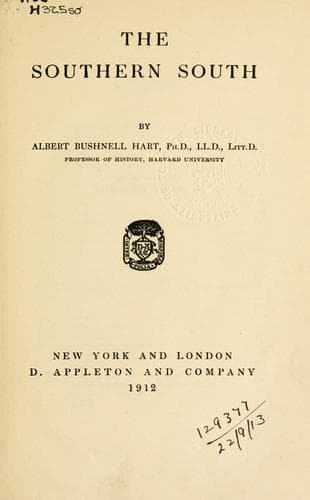
Southern States -- Social conditions; United States -- Race relations
The African in America has had little opportunity to work out a
civilization of his own, and it certainly cannot be charged against him as
a fault that he has accepted the white civilization which was at first
forced upon him. As one of their own number says: "The Negro has advanced
in exactly the same fashion as the white race has advanced, by taking
advantage of all that has gone before. Other men have labored and we have
entered into their labors." Yet, having accepted a heritage of literature,
law and religion, from his white brother, the Negro cannot escape from the
standard of the white man among whom he lives who have had like
opportunities; and if he does not measure up to it it is impossible to
avoid the conclusion that the race is inferior. Either the Negro is a
white man with a black skin, who after a reasonable term of probation must
now take the responsibilities of equal character (though not as yet of
equal performance), or else it must be admitted that, though a man, he is
a somewhat different kind of man from the White.
A favorite Southern phrase is: "The Negro is a child," and many
considerable people accord him a child's privileges. The ignorant black
certainly has a child's fondness for fun, freedom from care for the
morrow, and incapacity to keep money in his pocket; but some planters will
talk to you all day about the shrewdness with which he manages to get
money out of the unsuspecting white man; and when it comes to serious
crime, it is not every judge who makes allowance for childishness in the
race. The theory that the negro mind ceases to develop after adolescence
perhaps has something in it; but there are too many hard-headed and
far-sighted persons, both full bloods and mulattoes, who have unusual
minds, to permit the problem to be settled by the phrase, "The Negro is a
child."
Genuine friends and well-wishers of the Negro feel intensely the
irresponsibility of the race. A business man who all his life has been
associated with them says: "He has all the good qualities of the lazy,
thriftless person, he is amiable, generous and tractable. He has no
activity in wrongdoing. He has the imitative gift in a remarkable degree,
and always I love him for his faults, he is without craftiness, without
greed. You will find no Rockefellers nor Carnegies among them. He is not a
scoundrel from calculation.... He takes as his pattern the highest type of
white man he is acquainted with. He has no sort of regard for what he
thinks the poor white trash.... I don't know how best to help him, but I
like him, like him and his careless devil-may-care ways. I like him
because his whole soul is not absorbed in this craze for getting money. I
like him because he does no evil by premeditation, because he sees no
evil in everything he does, then goes and does it. I like him because some
day in the distant past I was like him."
Public-domain text, read in full here on John Shaqi.
Reviews
Reviews
No reviews yet
Be the first to share your thoughts on this work.
Elsewhere in the archive
Join the Discussion
Join the discussion
Sign in to leave a comment or review.
Sign InorCreate an account