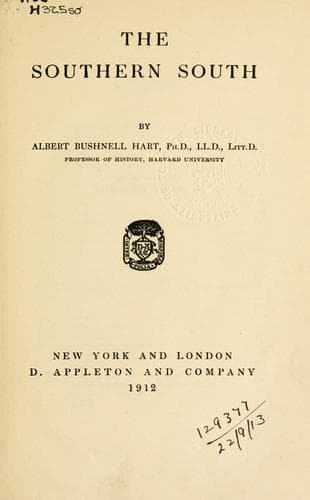
Southern States -- Social conditions; United States -- Race relations
The main issue must be fairly faced by the friends as well as the enemies
of the colored race. Measuring it by the white people of the South, or by
the correspondingly low populations of Southern or Northern cities, the
Negroes as a people appear to be considerably below the Whites in mental
and moral status. There are a million or two exceptions, but they do not
break the force of the eight or nine millions of average Negroes. A larger
proportion of the mulattoes than of the pure bloods come up to the white
race in ability; but if fifty thousand people in the negro quarter of New
Orleans or on the central Alabama plantations be set apart and compared
with a similar number of the least promising Whites in the same city or
counties, fewer remarkable individuals and less average capacity would be
found. Race measured by race, the Negro is inferior, and his past history
in Africa and in America leads to the belief that he will remain inferior
in race stamina and race achievement.
CHAPTER IX
NEGRO LIFE
The negro problem in the South cannot be solved, nor is much light thrown
upon it by the conditions of the race elsewhere. The immediate and
pressing issue is the widespread belief that the great numbers of them in
the South are an unsatisfactory element of the population. The total
Negroes in the United States in 1900, the last available figures, was
8,834,000. They are, however, very unequally distributed throughout the
Union; in twenty Northern states and territories there are only 50,000
altogether; in the states from Pennsylvania northward there are about
400,000; from Ohio westward about 500,000; while in the one state of
Georgia there are over a million; 7,898,000 lived in the fifteen former
slaveholding states; 7,187,000 in the eleven seceding states; and
5,055,000 in the seven states of the Lower South. At the rate of increase
shown during the last forty years there will soon be 10,000,000 in the
South alone. These figures have since 1900 been somewhat disturbed by the
natural growth of population and by the interstate movement, so that the
proportion of blacks in the North is doubtless now a little larger; but
the fact remains that the habitat of the black is in the Southern States.
Even there, great variations occur from state to state, and from place to
place. In Briscoe County, Texas, there are 1,253 Whites and not a single
Negro; in Beaufort County, S. C., there are 3,349 Whites and 32,137
Africans; on the island of St. Helena in this last county are 8,700
colored and 125 white people; and on Fenwick's Island there are something
like 100 Negroes and not a white person.
Public-domain text, read in full here on John Shaqi.
Reviews
Reviews
No reviews yet
Be the first to share your thoughts on this work.
Elsewhere in the archive
Join the Discussion
Join the discussion
Sign in to leave a comment or review.
Sign InorCreate an account