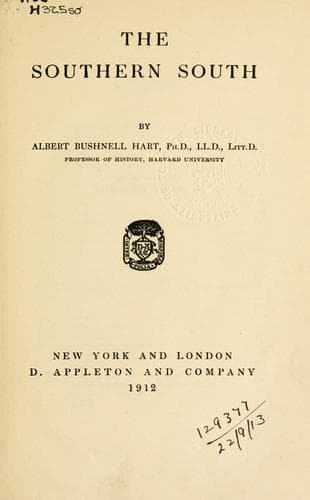
Southern States -- Social conditions; United States -- Race relations
The status of the Negroes is in many ways altered by the steady though
limited movement from South to North. The Negroes are subject to waves of
excitement, and in 1879 a colored agitator created a furore for
colonization by spreading abroad the news that in Liberia there was a
"bread tree" and another tree which ran lard instead of sap, so that all
you had to do was to cut from one and catch from the other. A systematic
effort has been made to settle colored people in Indiana, in order to hold
that State in the Republican column; and there are now probably nearly a
hundred thousand there, a third of whom are settled in Indianapolis, where
they furnish a race problem of growing seriousness. The Negroes in the
city of Washington have increased eight times in forty years. They have
repeatedly been brought into the North as strike breakers, often with the
result of serious riots. In 1879 thousands of them left various parts of
the South for Kansas, and in some cases the river boats refused to take
them. As a result some Southern states passed statutes requiring heavy
license fees (sometimes as much as $1,000 a year) from labor agents who
should induce people to go to other states. Nevertheless, there are now
over 50,000 in Kansas and over 100,000 in the neighboring new State of
Oklahoma. At present there are in New York and Philadelphia nearly a
hundred agents who draw Negroes northward, and they bring thousands of
people every year, chiefly to enter domestic service. The movement is ill
organized and does not by any means include the most thrifty, since
passage money is often advanced by the agents.
The numbers of the Negroes are not in themselves alarming. In most
Southern states they are fewer in proportion than the foreign element in
many Northern states. The hostility to the Negro is not based on his
numbers, but on his supposed inferiority of character. On this point there
is a painful lack of accurate knowledge, because there is so little
contact between the Whites and their negro neighbors. The white opinion of
the blacks is founded with little knowledge of the home life of the other
race. How many white people in the city of Atlanta, for instance, have
actually been inside the house of a prosperous, educated Negro? How many
have actually sat over the fire of a one-room negro cabin? The Southern
Whites, with few exceptions, teach no Negroes, attend no negro church
services, penetrate into no negro society, and they see the Negro near at
hand chiefly as unsatisfactory domestic servants, as field hands of
doubtful profit, as neglectful and terrified patients, as clients in
criminal suits or neighborhood squabbles, as prisoners in the dock, as
convicted criminals, as wretched objects for the vengeance of a mob.
Public-domain text, read in full here on John Shaqi.
Reviews
Reviews
No reviews yet
Be the first to share your thoughts on this work.
Elsewhere in the archive
Join the Discussion
Join the discussion
Sign in to leave a comment or review.
Sign InorCreate an account