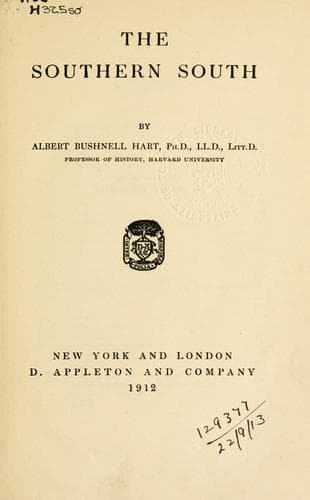
Southern States -- Social conditions; United States -- Race relations
An encouraging sign is the disposition of both white and colored
investigators to study the Negro in his home. Professor DuBois has
directed such researches both in Southern cities and in the open country;
there are also two monographs upon the religious life of the Negro, one
directed by Vanderbilt University and the other by Atlanta University; and
Mr. Odum, of the University of Mississippi, has prepared a study upon the
Negro in fifty towns in various states which, still in manuscript, is one
of the most instructive inquiries ever made into negro life.
Naturally, such investigations are easier in the cities, and we know much
more about the urban Negro, a sixth of the population, than of the rural
black, who are five sixths. In the large cities there is an African
population, a considerable part of which is prosperous. Here are the best
colored schools, the greatest demand for African labor, the largest
opportunity for building up small businesses among the Negroes themselves.
Here are to be found most of the rich or well-to-do Negroes; and there is
a large contingent of steady men employed in all kinds of capacities,
about whom there is little complaint. On the other hand, a broad fringe of
the population lives in houses or rooms actually less spacious and less
decent than the one-room cabin in the fields. This floating and unsteady
part of the negro race finds a favorable habitat in the towns and small
cities, where there is less opportunity for steady employment than in the
large cities. From this class come the domestic servants, who will be
considered in a later chapter.
Public-domain text, read in full here on John Shaqi.
Reviews
Reviews
No reviews yet
Be the first to share your thoughts on this work.
Elsewhere in the archive
Join the Discussion
Join the discussion
Sign in to leave a comment or review.
Sign InorCreate an account