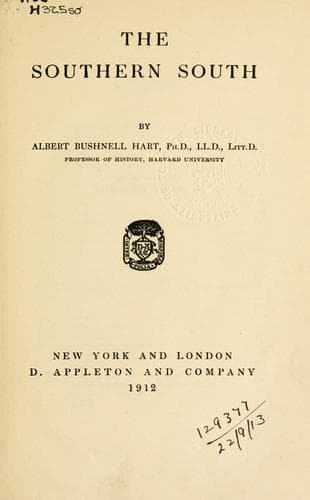
Southern States -- Social conditions; United States -- Race relations
Another of the statements, repeated so often that people believe them
without proof, is that the Southern Negro has lost his skilled trades. Two
Southern writers say: "Now, most of the bricklayers are white. The same
is true with respect to carpenter work. The trade of the machinist is
practically in the hands of white men." "They have been losing ground as
mechanics. Before the war, on every plantation there were first-class
carpenters, blacksmiths, wheelwrights, etc. Half the houses in Virginia
were built by Negro carpenters. Now where are they?" Nothing could better
illustrate the fact that Southerners who reprehend the interference of the
North in questions which it does not understand, are themselves myopic
guides. If the negro trades have disappeared, how does it come about that
in Montgomery, Ala., there are practically no other laborers of that type?
that the bricklayers, carpenters, masons, blacksmiths, are all Negroes,
and no white boys seem to be learning those trades. The census of 1890
showed in Alabama about 13,000 colored men who had some sort of skilled
employment, many of them in trades which did not exist in slavery times,
such as iron-working, steam fitting, and service on railroads. It is true
that they are shut out of most of the callings in which there is authority
over others; there are no negro motormen or trolley conductors, no negro
engineers, though plenty of firemen; no negro conductors, though negro
brakemen are not uncommon, and in Meridian, Miss., the trains are called
in the white waiting room by a buxom negro woman.
In some Southern cities Whites, very often Northern men, have absorbed
certain trades supposed to be the peculiar province of the Negro: barber
shops with white barbers are found; the magnificent Piedmont Hotel in
Atlanta has a corps of white servants; wherever the trades unions get into
the South they are likely to work against the Negro; but in some cases he
has unions of his own; or there are joint unions of Whites and Negroes.
Considering the great opportunity for white men in callings where blacks
are not admitted it does not seem likely that they will ever be excluded
from skilled trades, though subject to more competition than in the past.
Public-domain text, read in full here on John Shaqi.
Reviews
Reviews
No reviews yet
Be the first to share your thoughts on this work.
Elsewhere in the archive
Join the Discussion
Join the discussion
Sign in to leave a comment or review.
Sign InorCreate an account