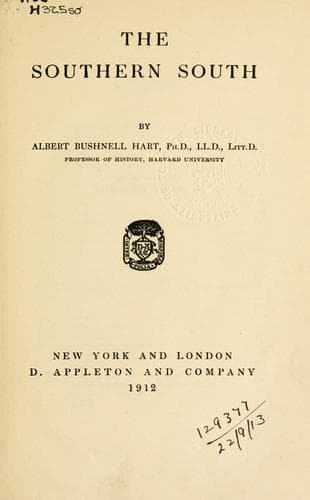
Southern States -- Social conditions; United States -- Race relations
Another employment for which the African has in many ages and countries
been found suited is military service. Even in slavery times military
companies of free Negroes were not unknown, and some of them actually went
to the front for the Confederacy in the first weeks of the Civil War. Then
came the enlistment of nearly 200,000 in the blue uniform, and after the
war some thousands of men remained in negro regiments. A brief attempt to
educate colored officers in West Point and Annapolis was, for whatever
reason, not a success; and the negro troops are almost wholly under the
command of white officers. Since Reconstruction times negro militia
companies have not been encouraged, and in some states have been wholly
disbanded. The difficulty in Brownsville, Texas, in 1907, has tended to
prevent negro enlistment in the army and navy. In the Spanish War and
later in the Philippines negro regiments gave a good account of
themselves. There are a few negro policemen in the cities, but in the
South they are likely to disappear. The white man resents any assertion of
authority over him by a Negro, and in general considers him unfit to
exercise control over people of his own race.
Even in ante-bellum times there were occasional negro business and
professional men, some of whom had the confidence of their white neighbors
and made little fortunes. Since the Civil War these avenues have much
widened. The 16,000 or 17,000 ministers are still to a large degree
uneducated persons, as indeed is the case in many white churches. Negro
physicians are numerous, educated partly in Northern institutions, partly
in medical colleges of their own, partly in schools officered by white
professors, as, for instance, in Raleigh, N. C. Like the lawyers they
cannot practice without the certificate of state officers not very
friendly to them or easy to convince of their abilities; and the cream of
the practice among colored people goes to the Whites. In business, negro
merchants, manufacturers, builders, and bankers have become very numerous.
Recently a Negro Bankers' Convention was held in the South. Most of the
transactions of these men are carried on with their own people, though
they often find customers and credit with Whites. So far, there are few or
no large negro capitalists, but many promising groups of small capital
have been brought together; and at the Expositions of Charleston and
Jamestown they showed creditable exhibits of their own industries.
Two entirely new professions have opened up since the Civil War. The first
is that of journalist, and there are many negro newspapers, none of which
has any national circulation, or extended influence. The other is
teaching, which has opened up a livelihood to thousands of young men and
women. Some of the negro colleges are wholly manned by members of the
race, many of them graduates of Northern institutions, who seem to make
use of the same methods and appeal to the same aspirations as the
faculties of white colleges.
Public-domain text, read in full here on John Shaqi.
Reviews
Reviews
No reviews yet
Be the first to share your thoughts on this work.
Elsewhere in the archive
Join the Discussion
Join the discussion
Sign in to leave a comment or review.
Sign InorCreate an account