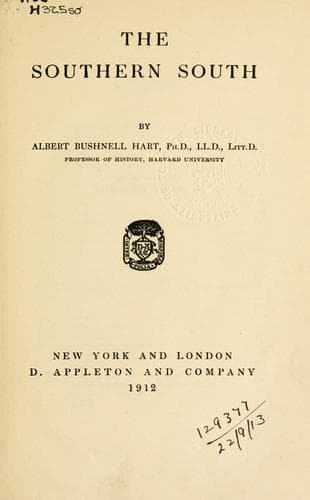
Southern States -- Social conditions; United States -- Race relations
An invariable answer to the plea that the character of the negro leaders
is a proof of the capacity for uplift is that they are substantially white
men. At the same moment the critics deny to those substantially white men
the privileges of actual white men. But may not "substantially white men"
have an uplifting influence such as indubitably white men had in earlier
times? Most candid white observers, however hostile to the race, admit
that somewhere from a tenth to a fourth of all the Negroes are doing well
and moving upward; and this applies to the Negro on the land as well as in
cities. In many scattered areas in the South, groups of plantation
Negroes have bought land and are saving money. Here are a few examples
taken from the writer's notebook:
At Calhoun, Ala., may be found nearly a hundred Negroes who have bought or
are buying their own farms, and have made $60,000 of savings to do it. A
negro woman on one of those farms said of her new house: "We don't need no
rider (overseer) now, dis house is our rider. It will send us into the
field, it will make us work, and it will make us plan. We's got to plan.
When Ise out in the pit I has to stop to look up at dis house, and den Ise
so pleased I don't know how I am working." Near Nixburg, Ala., is another
settlement started by a Negro, Rev. John Leonard, soon after the war,
which is called thereabouts "Niggerdom," because the blacks have acquired
the best tract of land in the region, have put up the best schoolhouse in
the county, and as a neighbor said of them: "They have got to the place
now where they're no more service to the Whites. They want to work for
themselves." At Kowaliga, Ala., is the Benson settlement, where a Negro
has bought his former master's plantation, largely extended it, has built
a dam and mill, owns three thousand acres of land with many tenants, and
is one of the few large planters of that section who combines cattle
raising with cotton. He gave land and assistance to a good school with
commodious buildings, carried on entirely by Negroes (including Tuskegee
graduates); is building what is probably the best planter's house in the
county, and has plenty of outside investments. At Mound Bayou, Miss., is
another purely negro settlement, with a population of about two thousand,
among whom not a single white man lives. Under the guidance of two
brothers named Montgomery, they bought their land direct from the
railroad company, claim to own 130,000 acres, and have paid for
considerable parts of it; maintain their own stores, carry on a little
bank, and elect a negro municipal government. The results show as much
capacity for managing their own affairs as the neighboring white towns.
Public-domain text, read in full here on John Shaqi.
Reviews
Reviews
No reviews yet
Be the first to share your thoughts on this work.
Elsewhere in the archive
Join the Discussion
Join the discussion
Sign in to leave a comment or review.
Sign InorCreate an account