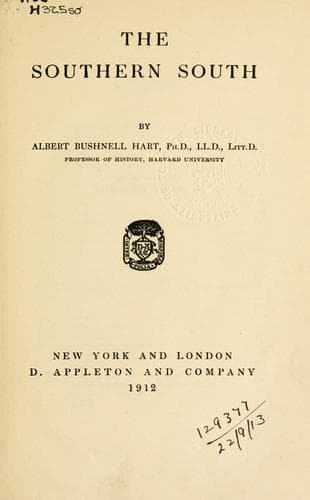
Southern States -- Social conditions; United States -- Race relations
There are two or three settlements of the same kind in the South, on a
smaller scale, as at Goldsboro, Fla., and one in Alabama. Different in
type, but a proof of prosperity, are the negro settlements on the Sea
Islands; here is no personal leader like Leonard, or Benson, or
Montgomery; but on several of the islands is a large group of colored
landowners who have been there ever since the Civil War, and whose houses
are much superior to the usual negro cabins. While not progressive, they
hold on to their land with great tenacity, and are not running into debt.
These specific examples prove beyond question that Africans can advance.
Every one of the settlements above mentioned is planted in an unpromising
region, among Negroes presumably of a lower type than the average. Lowndes
County, in which Calhoun is situated, is one of the most backward in the
South; the Sea Islands have the densest negro population to be found
anywhere. Similar instances, on a smaller scale may be found in every
state and almost every county of the South. However backward the people,
you are everywhere told that a few save money, buy land, and try to give
their children better conditions. Nor is it the mulattoes only who show
this disposition to get on in the world; the pure Negroes sometimes are
the most industrious and sensible of their race.
Houses and lands are not the only measure of uplift; and the numerous
Negroes who, according to the impression of white men not likely to
exaggerate, are really thrifty, might be unable to raise the average of
their race; but it seems clear that the Negro is nowhere reverting to
barbarism; that a considerable part of the race, certainly one fourth to
one fifth, is doing about as well as the lowest million or two of the
Southern Whites; though perhaps a fifth (of whom a great part are to be
found in towns and cities) are distinctly doing ill; that the Negroes on
the land, though on the average low, ignorant, and degraded, are working
well, making cotton, and helping to enrich the South. For, as one of
themselves puts it: "The native ambition and aspiration of men, even
though they be black, backward, and ungraceful, must not lightly be dealt
with." The real negro problem is the question of the character and the
future of the laborer.
But deep in the breast of the Average Man
The passions of ages are swirled,
And the loves and the hates of the Average Man
Are old as the heart of the world--
For the thought of the Race, as we live and we die,
Is in keeping the Man and the Average high.
Public-domain text, read in full here on John Shaqi.
Reviews
Reviews
No reviews yet
Be the first to share your thoughts on this work.
Elsewhere in the archive
Join the Discussion
Join the discussion
Sign in to leave a comment or review.
Sign InorCreate an account