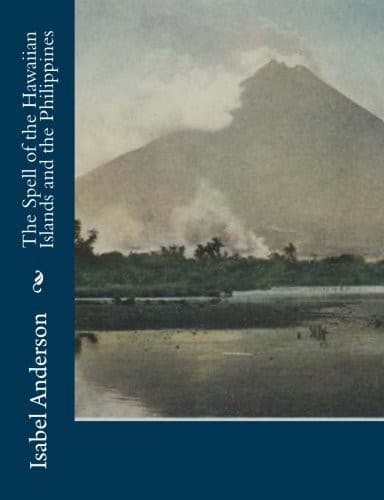
The Spell of the Hawaiian Islands and the PhilippinesAnderson, Isabel
History
The Spell of the Hawaiian Islands and the Philippines
Anderson, Isabel
Hawaii; Philippines
Isaac Davis and John Young were two of these men. When the crew of an
American vessel was massacred these two were spared, and they continued
to live in the Islands until their death. They were a bright contrast to
most seamen who visited Hawaii at that period. They accepted the
responsibility imposed by their training in civilization, exerting a
great influence for good, and were even advisers and teachers of King
Kamehameha I.
Captain George Vancouver, who visited the Islands three times in the
last decade of the eighteenth century under commission from the British
Government, was another white man whose work there was wholly good. He
landed the first sheep and cattle ever seen there, and induced the king
to proclaim them tabu for ten years so that they might have time to
increase, after which women were to be allowed to eat them as well as
men. He introduced some valuable plants, such as the grapevine, the
orange and the almond, and brought the people seeds of garden
vegetables. He refused them firearms. Under his direction the first
sailing vessel was built there and called the _Britannia_. Vancouver so
won over the natives by his kind treatment that the chiefs ceded the
Islands to Great Britain and raised the British flag in February, 1794.
He left them with a promise to come again and bring them teachers of
Christianity and the industries of civilization. His death, however,
prevented his return, and Great Britain never took formal possession.
Kamehameha I, who, at the time of Cook's arrival, was only a chief on
the island of Hawaii, joined in the tribal wars, conquered the other
chiefs of that island, and became king. While this conquest was in
progress, an eruption of Kilauea destroyed a large part of the opposing
army and convinced Kamehameha that Pele was on his side.
The subjugation of Maui and Oahu followed. At the great battle fought in
the Nuuanu Valley, the king of Oahu was defeated and driven with his
army over the Pali. Kamehameha was twice prevented from invading Kauai,
but some years later it was ceded to him by its ruler.
After the conquest of Oahu was completed, in 1795, it was Kamehameha's
work to build up a strong central government. According to the feudal
system that had existed in the Islands up to that time, all the land was
considered to belong to the king, who divided it among the great chiefs,
these in turn apportioning their shares among the lesser chiefs, of whom
the people held their small plots of ground. All paid tribute to those
above them in rank. Kamehameha I, in order to increase his own power and
destroy that of the chiefs, distributed their lands to them in widely
separated portions rather than in large, continuous tracts, as had been
the custom previously.
Public-domain text, read in full here on John Shaqi.
Reviews
Reviews
No reviews yet
Be the first to share your thoughts on this work.
Join the Discussion
Join the discussion
Sign in to leave a comment or review.
Sign InorCreate an account