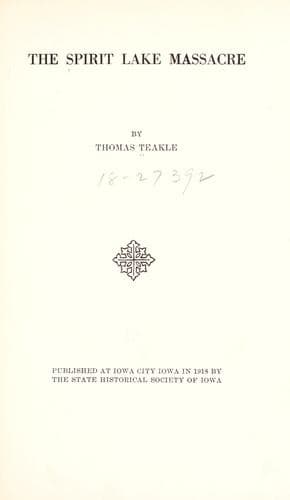
Indians of North America -- Iowa; Spirit Lake Massacre, Iowa, 1857
To the activities of another type of frontiersman, the trader, Indian
wars were sometimes due. In many instances the trader was an
individual who was unable to earn an honest living among his white
neighbors further east: necessity had made of him an exile from
civilization. These traders secured the confidence and good esteem of
the Indians in various and devious ways, and the latter soon became
indebted to them. In fact their deliberate aim in most cases was to
secure upon the Indian a leverage of such a character as to render
necessary the surrender of most of the Indian’s profits from the chase
or treaties. Because of the Indian’s profligacy it was necessary that
he should buy on credit if he bought at all. When government payments
became due, traders were always on hand, and their books invariably
showed Indian indebtedness enough to absorb a considerable portion if
not all of the payment. The Indians kept no books as a matter of
course; and not understanding those of the traders, they could not
deny the debt. As a matter of fact, the Indians were always willing to
anticipate the next payment in order to get credit. In the face of
this situation “the poverty and misery of the Indian were continually
growing”. Again, the Indian could not sue in the courts if he had so
desired. Out of such conditions trouble or bad feeling inevitably
arose.[26]
Owing to their long residence in the Indian country and their keen
knowledge of Indian character, the traders had become “the power
behind the throne”. This was especially true in treaty-making. The
Indian commissioners grew to realize the power of the traders in the
securing of treaties and were not slow to request their services. It
was to the financial interest of the traders that treaties should be
made, for thus there was insured a steady supply of money with which
the Indians could pay their debts. “The commissioners did not do much
more than feed the Indians and indicate what they wanted; the traders
did the rest.”[27] Due to their influence, the government habitually
incorporated in treaties a clause providing for the compulsory payment
of the Indian debts to the traders. These debts, in some cases, were
in the aggregate equivalent to small fortunes. To prevent abuses, the
traders were to be paid out of the first cash annuities.[28] It was
not an uncommon thing to have these debts absorb even more than these
first annuities. Hence, the Indian had to wait long for his first
money. Concerning this plan the Indians were not always consulted, but
the traders expressed their satisfaction.
Public-domain text, read in full here on John Shaqi.
Reviews
Reviews
No reviews yet
Be the first to share your thoughts on this work.
Join the Discussion
Join the discussion
Sign in to leave a comment or review.
Sign InorCreate an account