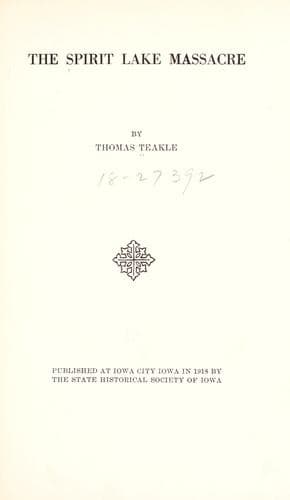
Indians of North America -- Iowa; Spirit Lake Massacre, Iowa, 1857
The murder of Sidominadota in all probability did not cause Inkpaduta
much concern. Moreover, it should be said at the outset that Inkpaduta
and Sidominadota were not brothers--as has so often been
claimed--since Inkpaduta was a Lower Sioux, a Wahpekuta; while
Sidominadota was an Upper Sioux, a Sisseton. Hence they could not have
been brothers. It is true that in some phases of Indian relationship
they might have been spoken of as brothers, but the conditions making
such a reference even remotely possible were not present in the case
of these two Indian leaders. Hence the theory of blood revenge can not
be accepted. Furthermore, the term “brother” with the Sioux was not
limited to blood relationship. “The tribe consists of a group of men
calling one another brother, who are husbands to a group of women
calling one another sister.” To call one another brother was a common
practice and carried with it no idea of relationship as ordinarily
interpreted.
Granting that the two were brothers, if Inkpaduta could not have
avenged the death within a year he could not have done so thereafter
according to the practice of blood revenge universally taught and
practiced among the Sioux. In religious practice and ceremonial
observance Inkpaduta was neither a heretic nor an outcast. The Sioux
have never been noted for retentive memories in matters of revenge,
but rather for their laxity.
Inkpaduta was superior to Sidominadota in rank; hence he would not
have succeeded him and could not have taken up blood revenge as his
successor. Moreover, these two men had bitterly disagreed, and
Sidominadota had severed all relation and connection with Inkpaduta or
any of his band and had grown to be one of the bitterest and most
vindictive of enemies. Inkpaduta knew this. It is likely that
Inkpaduta would have rejoiced at the news of his enemy’s death: it is
certain that the murder would not have caused him much if any concern.
“With him it was every man for himself; he never had a sentiment so
noble and dignified as that of revenge, and would not turn on his heel
to retaliate for the slaughter of his nearest friend.”[138]
Again, according to Siouan practice each band is absolutely separate:
one band must not concern itself with the affairs of another. War
would inevitably have followed such conduct. Although Inkpaduta was
lawless in many respects, no instance in which he broke over the
strict letter of this custom has come to light.
Finally, the bands were so widely separated and so busily engaged in
dodging each other that “it is doubtful whether Inkpadoota ever heard
the particulars of All Over Red’s murder; it is certain that he would
not have been concerned if he had.”
Public-domain text, read in full here on John Shaqi.
Reviews
Reviews
No reviews yet
Be the first to share your thoughts on this work.
Join the Discussion
Join the discussion
Sign in to leave a comment or review.
Sign InorCreate an account