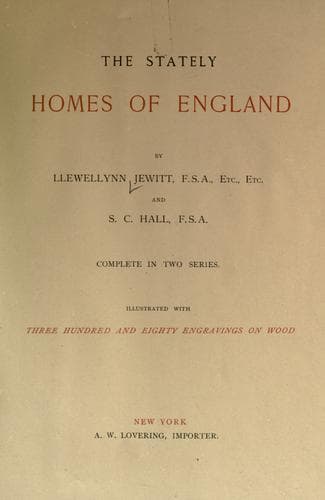
The Stately Homes of EnglandJewitt, Llewellynn Frederick William
History
The Stately Homes of England
Jewitt, Llewellynn Frederick William
Historic buildings -- England
Sir William Cavendish died in 1557, and his lady was thus a second time
left a widow. A few years later she married her third husband, Sir
William St. Loe, Captain of the Guard to Queen Elizabeth, “owner of a
great estate, which,” as Bishop Kennett says, “in articles of marriage
she took care should be settled on her and her own heirs, in default of
issue; and, accordingly, having no child by him, she liv’d to enjoy his
whole estate, excluding his former daughters and brothers;” thus adding
his property to the already immense possessions she had acquired in her
own right and by her two former marriages. The death of Sir William
left her for the third time a widow; but she was soon after wooed and
won by George, sixth Earl of Shrewsbury, who had not long before lost
his countess, Gertrude Manners, daughter of the Earl of Rutland. Before
she would consent, however, to be united to the first peer of the
realm, she stipulated that he should give his daughter to her eldest
son, and that Gilbert Talbot, his second son (the eldest being already
married) should espouse her youngest daughter. These family nuptials
were solemnised at Sheffield on the 9th of February, 1567-8; her
daughter being at the time not quite twelve years old, and her husband
being under fifteen. Gilbert Talbot became seventh Earl of Shrewsbury.
The history of the events of her life while Countess of Shrewsbury
is that of the kingdom at large; for it was during this time, from
1568 to 1584, that Mary, Queen of Scots, was confided to the care of
the earl and his lady, and by them was kept a close prisoner. Into
these annals—known by every student of English history—it is not our
province now to enter. Suffice it to say, that the wearisome task,
imposed by a rigorous and arbitrary sovereign, was executed with a
zeal and with a diligence that were worthy a far better cause. In 1568
the earl received from his royal mistress the intimation of the trust
she was about to confide to him, and on the 20th of the following
January, 1569, the order for removing Mary from Bolton to Tutbury was
made. Here the poor captive was received by the Earl and Countess of
Shrewsbury; and here, kept a close prisoner, she remained for several
months, passing her time as best she might in needlework. “I asked
hir grace,” says White, “sence the wether did cutt of all exercises
abrode, howe passed the tyme within? She sayd that all the day she
wrought with hir nydill, and that the diversitie of the colours made
the worke seme lesse tedious, and contynued so long at it till veray
payn made hir to give over; and with that layd hir hand upon hir left
syde and complayned of an old grief newely increased there.” In June
the earl removed her to Wingfield Manor, in Derbyshire, now, like
Tutbury itself, a splendid ruin; and later on in the same year back
again to Tutbury. In 1570 Mary was removed to Chatsworth, and from
thence to Sheffield, also now a ruin. Here she remained, occasionally
Public-domain text, read in full here on John Shaqi.
Reviews
Reviews
No reviews yet
Be the first to share your thoughts on this work.
Elsewhere in the archive
Join the Discussion
Join the discussion
Sign in to leave a comment or review.
Sign InorCreate an account