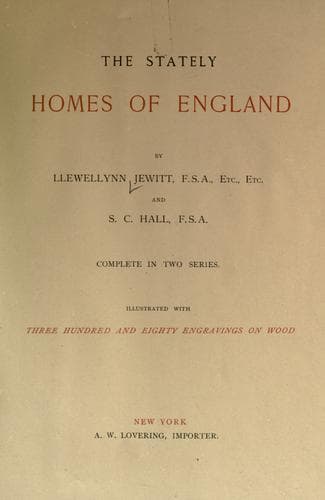
The Stately Homes of EnglandJewitt, Llewellynn Frederick William
History
The Stately Homes of England
Jewitt, Llewellynn Frederick William
Historic buildings -- England
staying at Chatsworth for some length of time. In 1584 she was again
removed to Wingfield, in 1585 to Tutbury, and in the following year to
Chartley, to Fotheringhay, and that fatal block, which will ever remain
a dark blot on the escutcheon of “good Queen Bess.” It is a somewhat
remarkable circumstance, touching the captivity of Mary under the
constableship of the Earl of Shrewsbury, that the places belonging to
him where she was confined, Sheffield Castle and Manor, Tutbury Castle,
Wingfield Manor, and Chartley (as well as Fotheringhay, where she was
executed), have all fallen to ruin, while Chatsworth and other places
which belonged to the countess still flourish.
It is not certain, although there is every probability that such was
the case, that Mary was ever at Hardwick. There can be but little doubt
she spent, at all events, a few days there; but this would, of course,
be at the old Hall, as will be shown later on.
The Earl of Shrewsbury, about whom strange rumours regarding his
conduct and intentions towards his captive at the time of his
discharge from his trust were afloat, and over whom a female domestic,
Eleanor Britton, had gained an injurious ascendency, afterwards, in
consequence, living a not very happy life with his second countess,
died in 1590; and thus “Bess of Hardwick” became, for the fourth time,
a widow. “A change of conditions,” says Bishop Kennett, “that, perhaps,
never fell to the lot of one woman, to be four times a creditable and
happy wife, to rise by every husband into greater wealth and higher
honours, to have a numerous issue by one husband only; to have all
those children live, and all, by her advice, be creditably disposed of
in her lifetime; and, after all, to live seventeen years a widow in
absolute power and plenty.”
The countess, besides being one of the most beautiful, accomplished,
and captivating women of her day, was, without exception, the most
energetic, business-like, and able of her sex. In architecture her
conceptions were grand; while in all matters pertaining to the Arts,
and to comforts and elegancies of life, she was unsurpassed. To
the old Hall of her fathers, where she was born and resided, she
made vast additions—indeed, so much so as almost to amount to a
recreation of the place; and she entirely planned and built three of
the most gorgeous edifices of the time—Hardwick Hall, Chatsworth, and
Oldcotes—the first two of which were transmitted entire to the first
Duke of Devonshire. “At Hardwick she left the ancient seat of her
family standing, and at a small distance, still adjoining to her new
fabric, _as if she had a mind to preserve her Cradle, and set it by her
Bed of State_,” as Kennett so poetically expresses it.
Her “Bed of State”—the present Hall, erected by her—we have already
described. Her “Cradle”—the old Hall, wherein she was born and nursed,
but which is now in ruins—we shall describe presently.
Public-domain text, read in full here on John Shaqi.
Reviews
Reviews
No reviews yet
Be the first to share your thoughts on this work.
Elsewhere in the archive
Join the Discussion
Join the discussion
Sign in to leave a comment or review.
Sign InorCreate an account