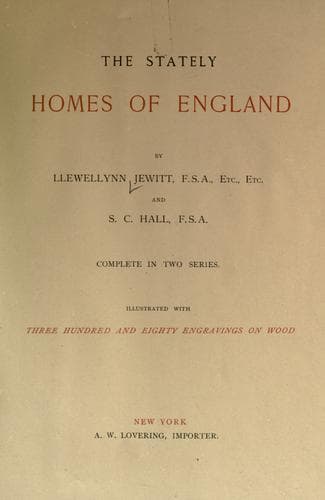
The Stately Homes of EnglandJewitt, Llewellynn Frederick William
History
The Stately Homes of England
Jewitt, Llewellynn Frederick William
Historic buildings -- England
The latter part of her long and busy life she occupied almost entirely
in building, and it is marvellous what an amount of real work—hard
figures and dry details—she got through; for it is a fact, abundantly
evidenced by the original accounts, remaining to this day, that not a
penny was expended on her buildings, and not a detail added or taken
away, without her special attention and personal supervision. Building
was a passion with her, and she indulged it wisely and well, sparing
neither time, nor trouble, nor outlay, to secure everything being done
in the most admirable manner. It is said, and it is so recorded by
Walpole, that the countess had once been told by a gipsy fortune-teller
that she would never die so long as she continued building, and she so
implicitly believed this, that she never ceased planning and contriving
and adding to her erections; and it is said that at last she died in a
hard frost, which totally prevented the workmen from continuing their
labours, and so caused an unavoidable suspension of her works. Surely
the fortune-teller here was a “wise woman” in more senses than one;
for it was wise and cunning in her to instil such a belief into the
countess’s mind, and thus insure a continuance of the works by which so
many workmen and their families gained a livelihood, and by which later
generations would also benefit.
[Illustration: _The Old Hall at Hardwick._]
Besides Hardwick, Chatsworth (for which a good part of the old Hall at
Hardwick was, at a later period, removed), Oldcotes, and other places,
the countess founded and built the Devonshire Almshouses at Derby, and
did many other good and noble works. She died, full of years and full
of honours and riches, on the 23rd of February, 1607, and was buried in
All Saints’ Church, Derby, under a stately tomb which she had erected
during her lifetime, and on which a long Latin inscription is to be
seen.
Of the countess—the “Bess of Hardwick,” who was one of the greatest
of the subjects of that other “Bess” who sat on the throne of
England—portraits are still preserved at Hardwick, and show that she
must have been, as Dugdale says of her, “faire and beautiful.” Whatever
faults of temper or of disposition she had—and she is said to have
had plenty of both—she had good qualities which, perhaps, outbalanced
them; and she, at all events, founded one of the most brilliant
houses—that of Cavendish—which this nation has ever produced.
Public-domain text, read in full here on John Shaqi.
Reviews
Reviews
No reviews yet
Be the first to share your thoughts on this work.
Elsewhere in the archive
Join the Discussion
Join the discussion
Sign in to leave a comment or review.
Sign InorCreate an account