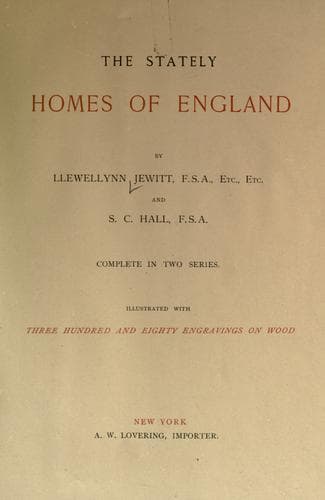
The Stately Homes of EnglandJewitt, Llewellynn Frederick William
History
The Stately Homes of England
Jewitt, Llewellynn Frederick William
Historic buildings -- England
[Illustration: _The Grave of Hobbes of Malmesbury in Hault Hucknall
Church._]
The monument to this great “philosopher” and free-thinker is a plain
slab of stone in the Hardwick Chapel—the raised slab shown on the
floor in this engraving—which bears the following inscription:—
CONDITA HIC SUNT OSSA
THOMÆ HOBBES,
MALMESBURIENSIS,
QVI PER MULTOS ANNOS SERVIVIT
DUOBUS DEVONIÆ COMITIBUS
PATRI ET FILIO
VIR PROBUS, ET FAMA ERUDITIONIS
DOMI FORISQUE BENE COGNITUS
OBIIT ANN^o DOMINI 1679,
MENSIS DECEMBRIS DIE 4º
ÆTATIS SUÆ 91.
Before speaking of Hobbes and his connection with Hardwick, where
he died, it will be well to note that the parish registers of Hault
Hucknall commence in the year 1662, and that the entry regarding the
burial of Hobbes, for the copy of which we have to express our thanks
to the Rev. Henry Cottingham, the respected vicar of the parish, is as
follows:—
“Anno Regni } 31 Law. Waine, { James Hardwick,
Caroli Sucund } _Vicar_. { Thomas Whitehead,
Anno dom. 1679. _Churchwardens_.
“Hardwick | Thomas Hobbs Magnus Philosophus,
Sepul. fuit et affidavit in Lana
Sepoliendo exhibit. Decem. 6” (or 8).
Thomas Hobbes[28] was born at Malmesbury on Good Friday, 1588, in
the year of “the Spanish Armada,” and it is said that his birth was
hastened by his mother’s terror of the enemy’s fleet, and that a
timidity with which through life he was afflicted was thus induced. He
and fear, he was wont to say, “were born together.” His being born on
Good Friday has also been turned to account in the way of accounting
for his wonderful precocity as a child, and his subsequent intellectual
progress. At the age of fifteen he was sent to Oxford, and there made
such progress that before he was twenty years old he was taken into
the service of Sir William Cavendish, who had a few years before been
created Baron Cavendish of Hardwick, as tutor to his sons, Gilbert,
who died before attaining his majority, and William, who became second
Earl of Devonshire. With the latter young nobleman, who married, as
already narrated, Christian, daughter of Lord Bruce, of Kinloss, Hobbes
travelled through France and Italy. At his death he left, besides
other issue, William, Lord Cavendish, who succeeded him as Earl of
Devonshire, and who, at that time, was only in the tenth year of his
age. This Lord Hardwick was, as his father had been before him, placed
under the tuition of Hobbes, “who instructed him in the family for
three years, and then, about 1634, travelled with him as his governor
into France and Italy, with the longest stay in Paris for all the
politer parts of breeding. He returned in 1637, and, when he soon after
came of age, his mother (Christian, Countess of Devonshire), delivered
up to him his great houses in Derbyshire all ready furnished.”
Public-domain text, read in full here on John Shaqi.
Reviews
Reviews
No reviews yet
Be the first to share your thoughts on this work.
Elsewhere in the archive
Join the Discussion
Join the discussion
Sign in to leave a comment or review.
Sign InorCreate an account