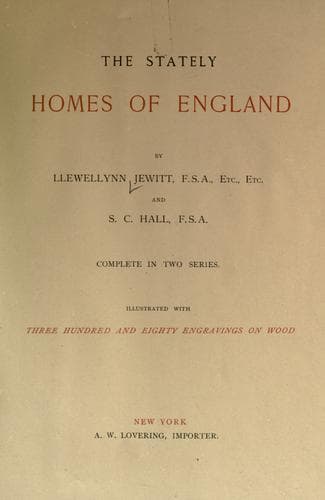
The Stately Homes of EnglandJewitt, Llewellynn Frederick William
History
The Stately Homes of England
Jewitt, Llewellynn Frederick William
Historic buildings -- England
With this nobleman (who married Elizabeth, daughter of the Earl of
Salisbury, and was succeeded by his son, afterwards created Duke of
Devonshire) Thomas Hobbes remained for the rest of his life. “The earl
for his whole life entertained Mr. Hobbes in his family as his old
tutor rather than as his friend or confidant; he let him live under his
roof in ease and plenty and his own way, without making use of him in
any publick or so much as domestick affairs. He would often express an
abhorrence of some of his principles in policy and religion; and both
he and his lady would frequently put off the mention of his name and
say ‘He was an humourist, and that nobody could account for him.’”
Of Hobbes’s works—of his “De Cive,” his “Leviathan,” his “Elémens
Philosophiques de Citoyen,” his “Behemoth,” or his hundred other
writings—it is, of course, not here our province to speak; but one
of his smaller productions, because of its connection with the family
of his noble patron, his “De Mirabilibus Pecci,” may claim a passing
word. This is a Latin poem descriptive of the “Wonders of the Peak, in
Derbyshire”—the same subject which Charles Cotton, later on, wrote
upon in his “Wonders of the Peak”—wherein Hobbes describes a tour
which he, with a friend, took on horseback, starting from Chatsworth,
where he was residing, and visiting Pilsley, Hassop, Hope, Castleton,
Peak Forest, Eldon Hole, the Ebbing and Flowing Well, Buxton, Poole’s
Hole, Chelmorton, Sheldon, Ashford, and so back to Chatsworth, quaintly
describing all he saw on his journey.
Public-domain text, read in full here on John Shaqi.
Reviews
Reviews
No reviews yet
Be the first to share your thoughts on this work.
Elsewhere in the archive
Join the Discussion
Join the discussion
Sign in to leave a comment or review.
Sign InorCreate an account