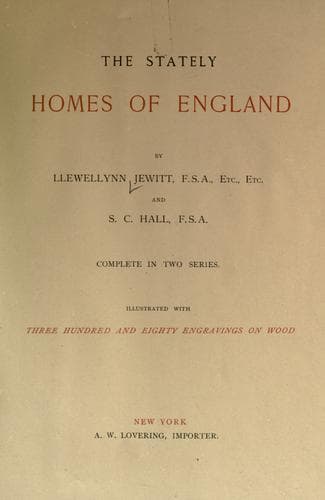
The Stately Homes of EnglandJewitt, Llewellynn Frederick William
History
The Stately Homes of England
Jewitt, Llewellynn Frederick William
Historic buildings -- England
Thus lived Hobbes, whether at Hardwick or at Chatsworth, and thus
were all his foibles kindly looked upon and administered to, and his
life made happy by allowing him in everything—even his attendance on
worship in the private chapel, and his leaving before the sermon—to
have, literally, “his own way.” In December, 1679, the earl and
countess went from Chatsworth to Hardwick Hall, probably with the
intention of keeping up their Christmas festivities there, and even
at that time the old man—for he was ninety-one years of age—would
accompany them. “He could not endure to be left in an empty house,
and whenever the earl removed he would go along with him, even to his
last stage from Chatsworth to Hardwick; when in a very weak condition
he dared not be left behind, but made his way upon a feather bed in a
coach, though he survived the journey but a few days. He could not bear
any discourse of death, and seemed to cast off all thoughts of it. He
delighted to reckon upon long life. The winter before he died he had
made a warmer coat, which he said must last him three years, and then
he would have such another. In his last sickness his frequent questions
were whether his disease was curable; and when intimations were given
that he might have ease, but no remedy, he used this expression:—‘I
shall be glad then to find a hole to creep out of the world at;’ which
are reported to have been his last sensible words, and his lying some
days following in a silent stupefaction did seem owing to his mind
more than to his body. The only thought of death that he appeared to
entertain in time of health was to take care of some inscription on his
grave. He would suffer some friends to dictate an epitaph, among which
he was best pleased with this honour, ‘_This is the true philosopher’s
stone_;’ which, indeed,” adds the bishop, “would have had as much
religion in it as that which now remains,” and of which we have just
given a copy.
Public-domain text, read in full here on John Shaqi.
Reviews
Reviews
No reviews yet
Be the first to share your thoughts on this work.
Elsewhere in the archive
Join the Discussion
Join the discussion
Sign in to leave a comment or review.
Sign InorCreate an account