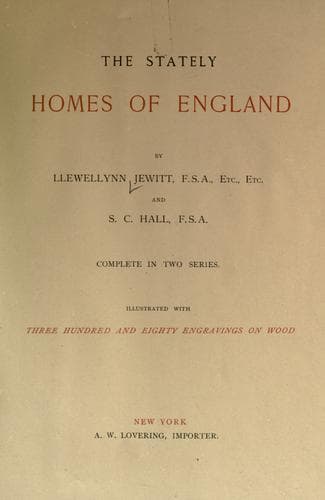
The Stately Homes of EnglandJewitt, Llewellynn Frederick William
History
The Stately Homes of England
Jewitt, Llewellynn Frederick William
Historic buildings -- England
As we have already remarked, it is not our business to discuss the
political or philosophical principles which Hobbes expressed in his
writings: these, both in and after his time, were the subject of much
controversy. We may, however, remark that it was well for those who
were committed to his tutelage and close companionship, that their
minds do not seem to have been corrupted by his avowed rejection, not
only of the Christian faith, but apparently of any faith at all in the
existence of a Deity. Nowhere—and he had abundance of opportunity in
some, at least, of his voluminous writings—does he show any glimmering
even of religious belief; and the history of his latest years, and the
last expression which proceeded from his mouth, testify to his fear of
death, and his dislike to have the subject mentioned in his hearing.
A mere materialist would not thus have been “subject to bondage,”
inasmuch as the conviction of utter annihilation must remove all ground
of apprehension regarding the “something after death.” Hobbes closed
his eyes a resolute doubter, if not an actual disbeliever; and no ray
of comfort or of hope came to brighten his last moments as he passed
into the world of spirits to exchange uncertainty for certainty, the
mortal for the immortal.
The late Sir William Molesworth endeavoured to rekindle some interest
in Hobbes’s writings by republishing an edition of his works: happily,
the attempt was a failure, so far, we believe, as to any extensive sale
of the poison contained in them.
Externally, Hault Hucknall Church, although highly picturesque and
venerable in appearance, presents not many striking features. The
tower, which stands between nave and chancel, was probably terminated
by a spire—the upper remaining part being of much later date than the
lower.
We have thus described the seat, next in importance to that of
Chatsworth, of the long-descended and long-ennobled family of
Cavendish. Their principal residence, Chatsworth, we describe and
illustrate in another part of this volume.
ARUNDEL CASTLE.
ARUNDEL castle takes high rank among the “Stately Homes of England.”
Some of its more prominent features we present to our readers. Of very
remote antiquity—for it traces back to a period long anterior to the
Conquest; deeply interesting in its historical associations—for it has
played a leading part in the principal events of the kingdom; and of
great importance in its family connections—for a long line of noble
and illustrious names, from the reign of Alfred the Great to our own
time, are associated with its history—Arundel stands, a proud monument
of England’s greatness, and of the beauty of England’s fair domains.
Public-domain text, read in full here on John Shaqi.
Reviews
Reviews
No reviews yet
Be the first to share your thoughts on this work.
Elsewhere in the archive
Join the Discussion
Join the discussion
Sign in to leave a comment or review.
Sign InorCreate an account