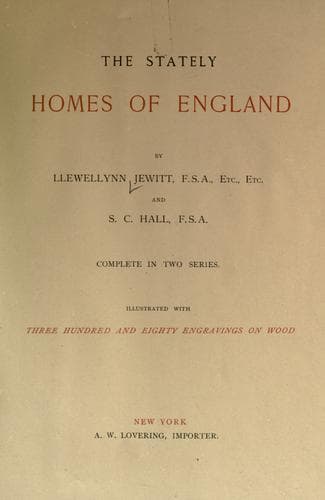
The Stately Homes of EnglandJewitt, Llewellynn Frederick William
History
The Stately Homes of England
Jewitt, Llewellynn Frederick William
Historic buildings -- England
The manor of Arundel was, it is stated, given in the will of Alfred
the Great (“Æthelme mines brother suna thone ham æt Ealdingburnam, &
æt Cumtune, & æt Crundellan, & æt Beadingum, & æt Beadingahamme, & æt
Burnham, & æt Thunresfelda, & æt Æscengum”) to his nephew, Æthelm,
the son of his brother. To Earl Godwine, and to King Harold, it is
also stated successively to have passed. At the time of the Norman
Conquest the possessions and the earldoms of Arundel, Chichester,
and Shrewsbury, were given to Roger de Montgomery, a relative of
the Conqueror, and “one of the council which formed the invasion of
England, leading the centre of the army in that famous battle of
Battle Abbey, wherein the crown accrued to the Norman.” He commanded
the entire army of archers and light infantry in the decisive battle;
and to his superior skill in military tactics was principally owing
the successful issue. To requite him for his valuable services, and
place him in a position of advantage, the Conqueror established him at
Arundel in all the magnificence of the age. Of his immense possessions,
those by which he was immediately surrounded constituted three
lordships, ten hundreds and their courts and suits of service, eighteen
parks, and seventy-seven manors. He took a prominent part in affairs of
state, both in the reign of the Conqueror and in that of William Rufus,
and at last entered the monastery at Shrewsbury, which he had founded,
and where he died. He was succeeded in his possessions in Normandy by
his eldest son, Robert, Comte de Belesme, and in his English earldoms
and possessions by his youngest son, Hugh, who led a turbulent life,
and met with a premature death at Anglesey, in repulsing the descent
made by Magnus, King of Norway, on that island; he was shot from his
horse by an arrow, which pierced through his brain.
On the death of Hugh, his elder brother, Robert, came over from
Normandy to claim the earldoms and inheritance, to which, on paying
a heavy fine, he succeeded. “He was a cruel, crafty, and subtle man,
but powerful in arms, and eloquent in speech, and for fifteen years
seldom out of rebellion; till at length peace being made between the
king and his competitor, he was called to account for all his actions,
but shifted away and fortified his castles, which the king (Henry I.)
besieged, and forced him to sue for clemency, which was granted; but
all his possessions were seized, and himself banished.” He ultimately
died in Warwick Castle—the earldoms reverting to the crown.
Public-domain text, read in full here on John Shaqi.
Reviews
Reviews
No reviews yet
Be the first to share your thoughts on this work.
Elsewhere in the archive
Join the Discussion
Join the discussion
Sign in to leave a comment or review.
Sign InorCreate an account