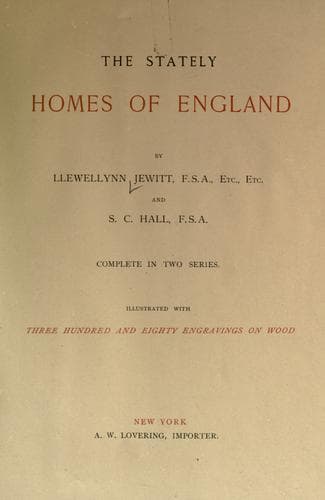
The Stately Homes of EnglandJewitt, Llewellynn Frederick William
History
The Stately Homes of England
Jewitt, Llewellynn Frederick William
Historic buildings -- England
Henry Charles, thirteenth duke, who was born in 1791, married, in 1814,
the Lady Charlotte Leveson Gower, daughter of the Duke of Sutherland
(she is still living), by whom he had issue, Henry Granville, Earl
of Surrey, who succeeded him; Lord Edward George Fitzalan Howard, of
Glossop Hall, Derbyshire, created, 1869, “Baron Howard, of Glossop;”
Lord Bernard Thomas; and the Ladies Mary Charlotte and Adeliza Matilda.
His Grace died in 1856, and was succeeded as fourteenth duke by his
eldest son, Henry Granville Fitzalan-Howard (who had assumed, by
royal sign-manual, in 1842, the surname of Fitzalan before that of
Howard). He married, in 1839, Augusta Mary Minna Catherine, daughter
of the first Baron Lyons (she still survives), by whom he had issue,
two sons, viz., Henry Fitzalan-Howard, the present Duke of Norfolk,
and Lord Edward Bernard Fitzalan-Howard; and seven daughters, viz.,
the Lady Victoria Alexandrina, born 1840, and married in 1861 to
James Robert Hope-Scott, Esq., Q.C.; the Lady Minna Charlotte, born
1843; the Lady Mary Adeliza, born 1845; the Lady Ethelreda, born
1849; the Lady Philippa, born 1852; the Lady Anne, born 1857; and the
Lady Margaret, born 1860. During the life of this nobleman, who was
universally beloved and respected, her Majesty Queen Victoria and the
Prince Consort paid a visit of three days to Arundel Castle, where the
reception was kept up with regal magnificence. His Grace died in 1860,
and was succeeded by his eldest son, then in his thirteenth year.
The present peer, his Grace Henry Fitzalan-Howard, fifteenth Duke
of Norfolk, Earl of Arundel, Earl of Surrey, Earl of Norfolk, Baron
Maltravers, Baron Fitzalan, Baron Clun, Baron Oswestry, Premier Duke
and Earl next to the blood royal, Hereditary Earl Marshal, and Chief
Butler of England, was born on the 27th of December, 1847, and attained
his majority in 1868. His grace is unmarried. He is the patron of seven
livings; but, “being a Roman Catholic, cannot present.”
The arms of the Duke of Norfolk are—Quarterly: first, _gules_, on a
bend between six cross-crosslets, fitchée, _argent_, an escutcheon,
_or_, charged with a demi-lion rampant, pierced through the mouth with
an arrow, within a double tressure, flory counter-flory, all _gules_,
for Howard; second, the arms of England (_gules_, three lions passant
guardant, _or_), charged with a label of three points, _argent_, for
difference, for Plantagenet; third, chequy, _or_ and _azure_, for
Warren; fourth, _gules_, a lion rampant, _argent_, for Mowbray. Crest,
on a chapeau _gules_, turned up, _ermine_, a lion statant-guardant,
_or_ ducally gorged, _argent_. Behind the arms two marshal’s staves
in saltire, _or_, enamelled at each end, _sable_. Supporters:—on the
dexter side a lion, _argent_, and on the sinister, a horse of the
same, holding in his mouth a slip of oak, fructed, _proper_. The motto
is “Sola Virtus Invicta.”
Public-domain text, read in full here on John Shaqi.
Reviews
Reviews
No reviews yet
Be the first to share your thoughts on this work.
Elsewhere in the archive
Join the Discussion
Join the discussion
Sign in to leave a comment or review.
Sign InorCreate an account