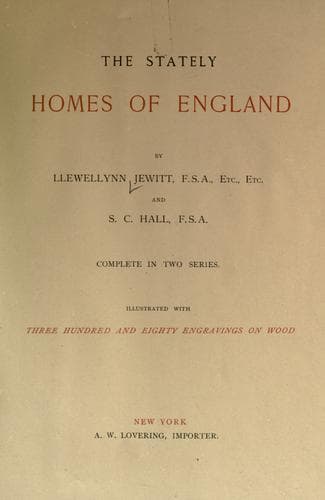
The Stately Homes of EnglandJewitt, Llewellynn Frederick William
History
The Stately Homes of England
Jewitt, Llewellynn Frederick William
Historic buildings -- England
Thus having briefly traced the history of the house of Howard, so far
as the main line connected with Arundel Castle is concerned, we turn
our attention to some of the many beauties and attractions of the
domain of Arundel.
In situation, as a fortress, few sites were so well chosen as that of
Arundel Castle. At the southern extremity of the elevated platform on
which it stands a strong wall enclosed the inner court, containing
upwards of five acres; on the north-east and south-east a precipitous
dip of the hill to ninety feet, rendered the castle inaccessible.
On the remaining sides a deep _fosse_, protected on the north by a
double vallation, and cutting off all external communication in that
direction, secured the garrison from any sudden incursion or surprise.
In the centre rose the Donjon, or Keep, circular in form, enormous
in strength, crowning a lofty artificial mound, and commanding a
wide and uninterrupted view of all the neighbouring approaches. “The
walls, from eight to ten feet in thickness, enclosed a nearly circular
space of more than sixty feet in diameter, and of great height—the
apartments being all lit from the central well-staircase, and there
being no loopholes in the walls. This Keep—which still stands in all
its venerable and hoary age—is supposed to have been built by Alfred
the Great, and to have been recased in Norman times, when the present
doorway was made. To the same period belongs a portion of the tower
near it, and which is connected with the Keep by a covered passage
carried across the moat. The Barbican, or Bevis’s Tower, occupying the
north-west side of the ditch surrounding the Keep, has also some good
Norman features, and it, as well as the Keep covered with luxuriant
ivy, and the old entrance, built by Fitzalan, form the most interesting
and picturesque portions of the venerable place.”
The entrance to the castle at the present time is at the top of High
Street. The approach is enclosed by embattled walls with turrets,
and the entrance gateway, surmounted by a portcullis and the arms of
Howard, is between two massive embattled towers: of this gateway we
give an engraving, taken from the interior. Following the carriage-way,
the visitor arrives at the entrance to the grand quadrangle, a massive
and lofty arched gateway flanked by two towers. Passing through this
gateway the appearance of the castle is grand and imposing. On the
right of the gateway is the CHAPEL, and adjoining it is the BARON’S
HALL, or Banqueting Chamber; on the south side is the grand, or state
entrance; and in the north-east wing is the Library, &c. None of these
buildings, however, are of ancient times.
[Illustration: _The Library._]
Public-domain text, read in full here on John Shaqi.
Reviews
Reviews
No reviews yet
Be the first to share your thoughts on this work.
Elsewhere in the archive
Join the Discussion
Join the discussion
Sign in to leave a comment or review.
Sign InorCreate an account