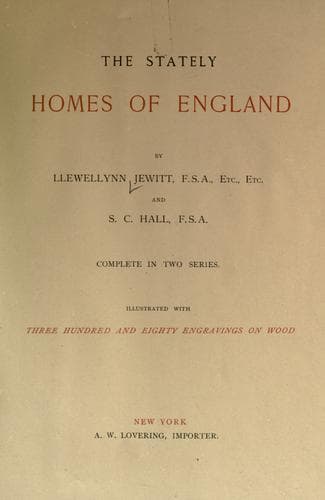
The Stately Homes of EnglandJewitt, Llewellynn Frederick William
History
The Stately Homes of England
Jewitt, Llewellynn Frederick William
Historic buildings -- England
One of the first objects that will be noticed by the visitor is a
bas-relief, which occupies a large space in the front wall of the
ALFRED SALOON, next to the Great Library. It represents Alfred the
Great instituting, or founding, trial by jury—the king himself
standing in the centre surrounded by his nobles and people, and
delivering a scroll, which he holds in his hand, bearing the words, in
Saxon characters, “That man fiœbe gemot on cum Wapentace” (That man, in
every hundred (Wapentake), shall find twelve jury). It was designed by
Rossi, a sculptor of modern time.
The castle is entered from this quadrangle or court-yard, by the grand
entrance, or state entrance, as it is called. This is a fine modern
doorway, of Norman design, in a machicolated central tower of three
stories in height. Over the doorway is a large central window, on
each side of which is a colossal figure of Hospitality and Liberty
respectively. Over this again are the arms of the Howards, sculptured,
and these again are surmounted by the machicolations, parapet, &c.
Immediately on entering this splendid ducal residence, the visitor
reaches the GRAND-STAIRCASE leading to its various apartments.
The BARON’S HALL, or BANQUETING CHAMBER, is a remarkably fine, and even
gorgeous, apartment. “Its architecture, like that of the chapel, is in
the style of the fourteenth century. It is 71 feet in length, by 35
in breadth, lofty in proportion, and, as a whole, produces a striking
effect on the spectator.” The roof is of Spanish chestnut, elaborately
carved, and the sculptures around the walls and on the windows are of
elegant design. The stained-glass windows are, however, “the grand
attraction, for in these the story of English freedom is brilliantly
told. They are thirteen in number. The great window illustrates the
ratification of the great charter by King John, who seems to pause
in the act of affixing his signature to the instrument.” Behind him
are several prelates, while to his right are the Pope’s Legate and
the Archbishop of Dublin, and, to his left, Cardinal Langton. There
are also Baron Fitzwalter, the Master of the Knights Templars, the
Lord Mayor, and others. In the other windows, which were superbly
executed by Eginton, one of the best of our artists in stained glass,
are full-length figures of eight barons of the Norfolk family, who
aided in procuring the charter—the heads, however, as well as those
in the large window, being portraits of members of the Howard family
of the beginning of the present century, at which time the windows
were executed. On the walls are several fine suits of armour, &c. This
magnificent hall was first opened on the 15th of June, 1815, being the
600th anniversary of the signing of the charter.
Public-domain text, read in full here on John Shaqi.
Reviews
Reviews
No reviews yet
Be the first to share your thoughts on this work.
Elsewhere in the archive
Join the Discussion
Join the discussion
Sign in to leave a comment or review.
Sign InorCreate an account