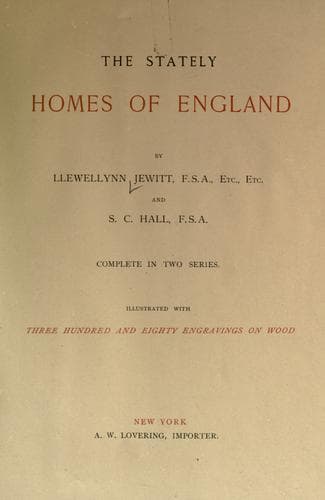
The Stately Homes of EnglandJewitt, Llewellynn Frederick William
History
The Stately Homes of England
Jewitt, Llewellynn Frederick William
Historic buildings -- England
The CHURCH OF THE HOLY TRINITY. All that remains of this once famous
establishment is a square building “enclosing a square yard, partly
occupied by cloisters, and partly devoted to other purposes of a
monastic establishment.” In it are some splendid monuments to members
of the noble families who have owned the place. One of the principal is
that of Thomas, Earl of Arundel, and his countess, Beatrix, daughter of
John, King of Portugal; and another striking feature is a canopied tomb
near the altar.
The CHURCH possesses many highly interesting features, and forms a
pleasing object in the landscape, from whichever side it is seen. It
is cruciform, and consists of a nave with side aisles, a chancel,
and transept; and in the centre rises a low tower, surmounted by a
diminutive spire.
The original ecclesiastical foundation was that of the alien priory, or
cell, dedicated to St. Nicholas, established by Roger de Montgomery,
Earl of Arundel, soon after the Conquest, and subjected to the
Benedictine Abbey of Seez, or de Sagio, in Normandy. It consisted
only of a prior and three or four monks, who continued to conduct the
establishment for nearly three centuries, until the third year of the
reign of Richard II., when Richard Fitzalan obtained a licence to
extinguish the priory and to found a chantry for the maintenance of a
master and twelve secular canons with their officers. Upon this change,
it was styled “the Church of the Holy Trinity.” At the suppression, it
was endowed with a yearly revenue of £263 14_s._ 9_d._
Being intended as the mausoleum of his family, the founder supplied
ample means to enrich it with examples of monumental splendour. The
tomb of his son, Thomas Fitzalan, and his wife, Beatrix, daughter of
John, King of Portugal, was the earliest of those placed in the church.
It is of alabaster, finely sculptured, and was formerly painted and
gilt. It contains the effigies of the earl and his lady; at the feet
of the earl is a horse, the cognizance of the Fitzalans; and at those
of his lady are two lap-dogs. Around, in niches, are small standing
figures of ecclesiastics, or pleureurs, with open books, as performing
funeral obsequies; and above them as many escutcheons. Other stately
tombs are erected to the memory of John Fitzalan and his wife, and
Thomas Arundel and his wife, “one of the eyres of Richard Woodevyle,
Earl Rivers, sister to Elizabeth, Queen of England, sometime wife to
King Edward IV.”
The chapel which contains these monuments is still in a dilapidated
state, as was the whole church—“ruinated” during the temporary
possession of the Iconoclasts of the Commonwealth—until Henry Charles,
Duke of Norfolk, restored it, and put upon it a roof, which it had long
been without.
Public-domain text, read in full here on John Shaqi.
Reviews
Reviews
No reviews yet
Be the first to share your thoughts on this work.
Elsewhere in the archive
Join the Discussion
Join the discussion
Sign in to leave a comment or review.
Sign InorCreate an account