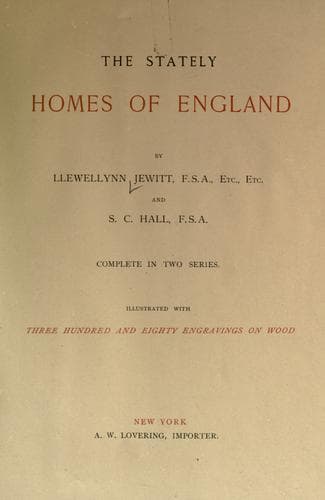
The Stately Homes of EnglandJewitt, Llewellynn Frederick William
History
The Stately Homes of England
Jewitt, Llewellynn Frederick William
Historic buildings -- England
Visitors to Arundel will note near the bridge some ancient ruins.
According to the historian, Tierney, they are the remains of the
_Maison Dieu_, that owed its origin to the same munificence as the
collegiate chapel and church. It formed a quadrangle, which was
occupied by the chapel, refectory, and its offices, and the various
chambers. There was a cloister round the court-yard. Quoting the
statutes, “the establishment,” says Mr. Tierney, “was to consist of
twenty poor men, either unmarried or widowers, who, from age, sickness
or infirmity, were unable to provide for their own sustenance. They
were to be selected from among the most deserving of the surrounding
neighbourhood, giving the preference only to the servants or tenants
of the founder and his heirs; they were to be men of moral lives and
edifying conversation, and were required, as a qualification for
their admission, to know the ‘Pater Noster,’ the ‘Ave-Maria,’ and the
‘Credo,’ in Latin.”
[Illustration: _Tombs of Thomas Fitzalan and Lady Beatrix, Arundel
Church._]
These buildings were dismantled at the time of the dissolution of the
monasteries, and no doubt suffered much at the time of the siege and
sack of Arundel, during the Civil War, by the Parliamentarians under
the command of Sir William Waller; in 1724 a large quantity of the
materials was used in the building of the bridge, that portion only
being rescued which is now seen, and which has been preserved by the
Duke of Norfolk because of the interest attached to the once sacred
structure.
Arundel, with its many attractions, is barely two hours distant from
London, and within half an hour of populous Brighton; yet visits of
strangers to the old town and venerable castle are comparatively few.
PENSHURST.
PENSHURST—the “Home” of the Sidneys—the stately Sidneys: stately
in their character, in their careers, in their patriotism, in their
heroism, in their rectitude, and in their verse—is surely one of the
best of the Stately Homes of England to be included in our series. The
very name of Penshurst seems to call up associations of no ordinary
character connected with that heroic race, and with many of the most
stirring incidents of British history. With Penshurst every great
name memorable in the Augustan age of England is linked for ever;
while its venerable aspect, the solemnity of the surrounding shades,
the primitive character of its vicinity, together with its isolated
position—away from the haunts of busy men—are in harmony with the
memories it awakens.
Public-domain text, read in full here on John Shaqi.
Reviews
Reviews
No reviews yet
Be the first to share your thoughts on this work.
Elsewhere in the archive
Join the Discussion
Join the discussion
Sign in to leave a comment or review.
Sign InorCreate an account