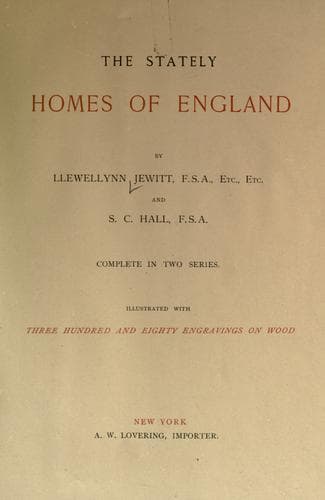
The Stately Homes of EnglandJewitt, Llewellynn Frederick William
History
The Stately Homes of England
Jewitt, Llewellynn Frederick William
Historic buildings -- England
Here lived the earliest and bravest of the Anglo-Norman knights. Here
dwelt the ill-fated Bohuns—the three unhappy Dukes of Buckingham,
who perished in succession, one in the field and two on the scaffold.
And here flourished the Sidneys! Here, during his few brief years of
absence from turmoil in the turbulent countries of Ireland and Wales,
resided the elder Sidney, Sir Henry, who, although his fame has been
eclipsed by the more dazzling reputation of his gallant son, was in all
respects good as well as great—a good soldier, a good subject, a good
master, and a good counsellor and actor under circumstances peculiarly
perilous. This is the birthplace of “the darling of his time,” the
“chiefest jewel of a crown,” the “diamond of the court of Queen
Elizabeth.” Here, too, was born—and here was interred the mutilated
body of—the “later Sidney:” he who had “set up Marcus Brutus for his
pattern,” and perished on the scaffold—a martyr for the “good old
cause,” one of the many victims of the meanest and most worthless of
his race. With the memories of these three marvellous men—the Sidneys,
Henry, Philip, and Algernon—are closely blended those of the worthies
of the two most remarkable eras in English history. Who can speak of
Penshurst without thinking of Spenser,
(“For Sidney heard him sing, and knew his voice,”)
of Shakspere, of Ben Jonson—the laureate of the place—of Raleigh,
the “friend and frequent guest” of Broke, whose proudest boast is
recorded on his tomb, that he was “the servant of Queen Elizabeth, the
counsellor of King James, and THE FRIEND of Sir Philip Sidney”—of the
many other immortal men who made the reign of Elizabeth the glory of
all time? Reverting to a period less remote, who can think of Penshurst
without speaking of the high spirits of a troubled age—
“The later Sidney, Marvel, Harrington,
Young Vane, and others, who called Milton—friend.”
Although its glory is of the past, and nearly two centuries have
intervened between the latest record of its greatness and its present
state; although it has been silent all that time—a solemn silence,
broken only by the false love-note of an unworthy minstrel, for the
names of “Waller” and “Sacharissa” discredit rather than glorify its
grey walls—who does not turn to Penshurst as to a refreshing fountain
by the wayside of wearying history?
[Illustration: _Penshurst, from the President’s Court._]
Public-domain text, read in full here on John Shaqi.
Reviews
Reviews
No reviews yet
Be the first to share your thoughts on this work.
Elsewhere in the archive
Join the Discussion
Join the discussion
Sign in to leave a comment or review.
Sign InorCreate an account