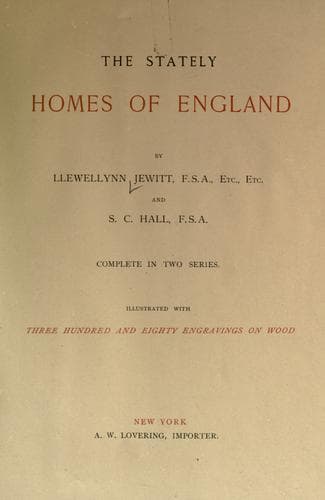
The Stately Homes of EnglandJewitt, Llewellynn Frederick William
History
The Stately Homes of England
Jewitt, Llewellynn Frederick William
Historic buildings -- England
By her he had a son, Sir William Sidney, who married Anne, daughter of
Hugh Pagenham, and by her had, besides Sir Henry, who succeeded him,
four daughters, viz.: Frances, who became Countess of Sussex by her
marriage to Thomas Ratcliffe, Earl of Sussex, Viscount Fitzwalter,
Lord Egremont and Burnell, Lord Chamberlain, Knight of the Garter, and
one of the Privy Council; Mary, married to Sir William Dormer; Lucy,
married to Sir James Harrington; and Anne, married to Sir William
Fitzwilliam. This Sir William Sidney was made a knight, 3rd Henry
VIII., at the burning of Conquest, and a banneret on Flodden Field,
5th Henry VIII. He was chamberlain to Prince Edward (afterwards Edward
VI.), and also steward of his household; and his wife was “governesse
of the sayd prince while he was in his nurse’s handes.” To him it
was that Penshurst was given by Edward VI. as a mark of affectionate
regard. Dying in 1553, he was succeeded by his son, Sir Henry Sidney,
who was a Knight of the Garter, Lord President of Wales, and one of the
Privy Council; he married Lady Mary, eldest daughter of John, Duke of
Northumberland, and by her had issue “the incomparable” Sir Philip,
and two other sons, Robert and Thomas, and a daughter, Mary, married
to Henry Herbert, Earl of Pembroke. This Henry Sidney was knighted,
3rd Edward VI., and was, when only twenty-two years of age, sent by
that amiable young monarch as ambassador to the French court. Under
Queen Mary he was Lord Treasurer of Ireland, and Lord Chief Justice,
and under Elizabeth was, in 1564, made Lord President of the Council in
the Marches of Wales; Knight of the Garter in 1564; and was twice Lord
Deputy of Ireland and Lord President of Wales.
Sir Henry Sidney had been brought up and educated with Edward VI.,
“being companion and many times the bedfellow of the prince;” and
that young king died in his arms. This death so affected Sir Henry,
“that he returned to Penshurst to indulge his melancholy. Here he soon
afterwards sheltered the ruined family of his father-in-law, the Duke
of Northumberland, in whose fall he would in all probability have been
implicated but for his retirement.” He died at Ludlow, the seat of his
government, in 1586—his heart being there buried, but his body was
interred with great solemnity, by the queen’s order, at Penshurst. The
concurring testimony of all historians and biographers, such as Camden,
Sir Richard Cox, Campian (in his “History of Ireland”), Hollinshed,
Anthony-à-Wood, and Lloyd (in his “State Worthies”), proves the
extraordinary courage, abilities, and virtue of Sir Henry Sidney. These
qualities made him the most direct and clear politician. He seems to
have been incapable of intrigue and the supple arts of the court. “His
dispatches are full, open, and manly; and Ireland, and perhaps Wales,
to this day experience the good effects of his wise government.”
Public-domain text, read in full here on John Shaqi.
Reviews
Reviews
No reviews yet
Be the first to share your thoughts on this work.
Elsewhere in the archive
Join the Discussion
Join the discussion
Sign in to leave a comment or review.
Sign InorCreate an account