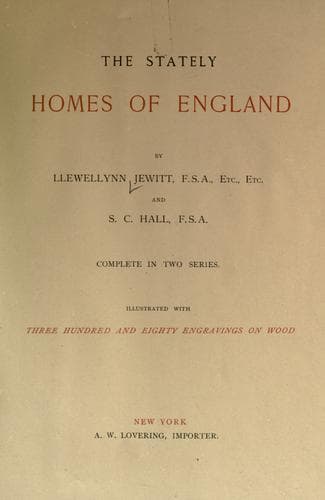
The Stately Homes of EnglandJewitt, Llewellynn Frederick William
History
The Stately Homes of England
Jewitt, Llewellynn Frederick William
Historic buildings -- England
“As the father was, so was the son;” the son being Sir Philip Sidney,
to whom we have alluded. Sir Philip was born at Penshurst, November
29th, 1554. His life was one scene of romance from its commencement to
its close. His early years were spent in travel; and on his return he
was married to the daughter of Sir Francis Walsingham, a lady of many
accomplishments, and of “extraordinary handsomeness,” but his heart was
given to another. The Lady Penelope Devereux won it, and kept it till
he fell on the field of Zutphen. Family regards had forbidden their
marriage, but she was united to the immortal part of him, and that
contract has not yet been dissolved. She is still the Philoclea of the
“Arcadia,” and Stella in the poems of “Astrophel.” It is unnecessary
to follow in detail the course of Sir Philip Sidney’s life. There is
no strange inconsistency to reason off, no stain to clear, no blame to
talk away.
[Illustration: _View from the Garden._]
We describe it when we name his accomplishments; we remember it as
we would a dream of uninterrupted glory. His learning, his beauty,
his chivalry, his grace, shed a lustre on the most glorious reign
recorded in the English annals. England herself, “by reason of the
widespread fame of Sir Philip Sidney,” rose exalted in the eyes of
foreign nations—he was the idol, the darling of his own. For with
every sort of power at his command, it was his creed to think all
vain but affection and honour, and to hold the simplest and cheapest
pleasures the truest and most precious. The only displeasure he ever
incurred at court was when he vindicated the rights and independence of
English commoners in his own gallant person against the arrogance of
English nobles in the person of the Earl of Oxford. For a time, then,
he retired from the court, and sought rest in his loved simplicity. He
went to Wilton; and there, for the amusement of his dear sister, Mary,
Countess of Pembroke, he wrote, between the years 1579 and 1581, the
“Arcadia,” a work whose strange fortune it has been to be too highly
valued in one age, and far too underrated in another. Immediately
after its publication it was received with unbounded applause. “From
it was taken the language of compliment and love; it gave a tinge of
similitude to the colloquial and courtly dialect of the time; and
from thence its influence was communicated to the lucubrations of the
poet, the historian, and the divine.” The book is a mixture of what
has been termed the heroic and the pastoral romance, interspersed
with interludes and episodes, and details the various and marvellous
adventures of two friends, Musidorus and Pyrocles. It was not intended
to be published to the world, but was written merely to pleasure the
Countess of Pembroke—“a principal ornament to the family of the
Sidneys.” The famous epitaph, usually ascribed to the pen of Ben
Jonson, though in reality, it appears, written by William Browne, the
author of “Britannia’s Pastorals,” and preserved in a MS.
Public-domain text, read in full here on John Shaqi.
Reviews
Reviews
No reviews yet
Be the first to share your thoughts on this work.
Elsewhere in the archive
Join the Discussion
Join the discussion
Sign in to leave a comment or review.
Sign InorCreate an account