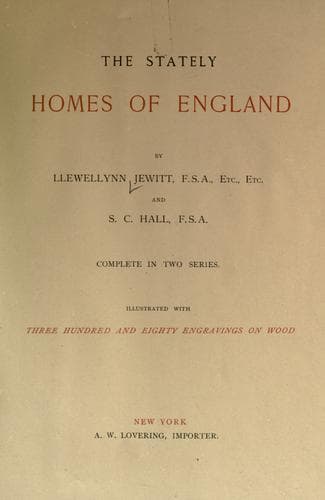
The Stately Homes of EnglandJewitt, Llewellynn Frederick William
History
The Stately Homes of England
Jewitt, Llewellynn Frederick William
Historic buildings -- England
then acting before the world. He joined the Parliament, and became a
busy soldier—serving with repute in Ireland, where he was “some time
Lieutenant-General of the Horse and Governor of Dublin,” until Cromwell
assumed the position of a sovereign, when Sidney retired in disgust to
the family seat in Kent, and began to write his celebrated “Discourses
on Government.” At the Restoration he was abroad, and “being so noted
a republican,” thought it unsafe to return to England; for seventeen
years after this event he was a wanderer throughout Europe, suffering
severe privations, “exposed (according to his own words) to all those
troubles, inconveniences, and mischiefs into which they are liable who
have nothing to subsist upon, in a place farre from home, wheare no
assistance can possibly be expected, and wheare I am known to be of a
quality which makes all lowe and meane wayes of living shamefull and
detestible.” The school of adversity failed to subdue the proud spirit
of the republican; and on his return to his native country, 1677, at
the entreaty of his father, “who desired to see him before he died,”
the “later Sidney” became a marked man, whom the depraved Charles and
his minions were resolved to sacrifice. He was accused of high treason,
implicated in the notorious Rye House Plot, carried through a form of
trial on the 21st of November, and beheaded on Tower Hill on the 8th of
December, 1683. His execution was a judicial murder.
Philip, third earl, lived to a great age, eighty-two, and dying in
1696, was succeeded by his grandson, John, who, dying unmarried, was
succeeded successively by two of his brothers; the last earl, Jocelyn,
died in 1748, without any legitimate issue. He, however, left a natural
daughter, afterwards married to Mr. Streatfield, to whom he devised the
whole of his estates. His next elder brother, Colonel Thomas Sidney,
who died before him, had, however, left two daughters, to whom the
estate properly devolved as co-heiresses; and after a long course
of litigation their right was established, and the guardians of the
young lady found it necessary to consent to a compromise (sanctioned
by Act of Parliament) with the husbands of the two co-heiresses. In
the division of the property, Penshurst passed to the younger of the
co-heiresses, Elizabeth, wife of William Perry, Esq. (who assumed the
name of Sidney), of Turville Park, Buckinghamshire, who repaired the
mansion, and added to its collection of pictures. He died in 1757, and
his widow, Mrs. Perry-Sidney, was left in sole possession. This lady,
after the death of her elder sister, Lady Sherrard, purchased most of
the family estates which had fallen to that lady’s share. A claim to
the estates and title of Earl of Leicester was made by a son of the
countess of the last earl (Jocelyn), born after her separation from her
husband, but was unsuccessful.
Public-domain text, read in full here on John Shaqi.
Reviews
Reviews
No reviews yet
Be the first to share your thoughts on this work.
Elsewhere in the archive
Join the Discussion
Join the discussion
Sign in to leave a comment or review.
Sign InorCreate an account