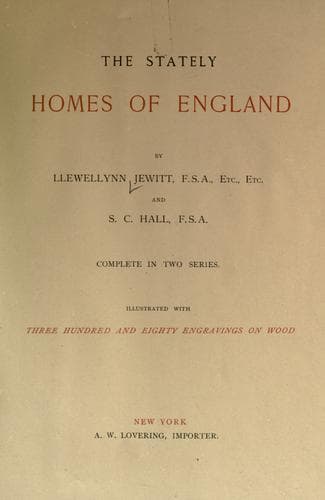
The Stately Homes of EnglandJewitt, Llewellynn Frederick William
History
The Stately Homes of England
Jewitt, Llewellynn Frederick William
Historic buildings -- England
We may place implicit faith in the testimony of the contemporaries of
Sir Philip Sidney; and by all of them he is described as very near
perfection. Their praises must have been as sincere as they were
hearty; for his fortune was too poor to furnish him with the means
to purchase them with other than gifts of kindly zeal, affectionate
sympathy, cordial advice, and generous recommendations to more
prosperous men. From Spenser himself we learn that Sidney
“First did lift my muse out of the floor.”
In his dedication of the “Ruins of Time” to Sidney’s sister, he speaks
of her brother as “the hope of all learned men, and the patron of my
young muse.” “He was,” writes Camden, “the great glory of his family,
the great hope of mankind, the most lively pattern of virtue, and the
darling of the learned world.”
[Illustration: _The Baron’s Court._]
Sir Philip, dying without issue, was succeeded by his brother, Sir
Robert Sidney, who was created Lord Sidney of Penshurst, and afterwards
Viscount Lisle and Earl of Leicester, and a Knight of the Garter, by
James I. He died at Penshurst in July, 1626, and was succeeded in his
title and estates by his son, Robert, as second Earl of Leicester. This
nobleman was “several times ambassador to foreign courts, and in 1641
was appointed Lord-Lieutenant of Ireland, but, through some unfounded
aspersions cast against his fidelity and honour, he was never permitted
to seat himself in his new station, and was ultimately dispossessed of
it.” He retired in disgust to Penshurst, where he spent his time in
literary retirement, for he was well read in the classics, and spoke
Latin, French, Italian, and Spanish, and purchased most of the curious
books in those languages, “and several learned men made him presents
of their works.” He remained in retirement at Penshurst during the
domination of the Parliament and the rule of the Protector, and died
there in November, 1677, in the eighty-second year of his age. His
lordship, who married the Lady Dorothea Percy, had fourteen children,
six sons and eight daughters. His eldest son, Philip, succeeded to the
title and estates, and lived in troubled times the life of an easy
gentleman. Not so the second son, Algernon, the famous scion of the
Sidneys, whose name is scarcely less renowned in history than that of
his great-uncle, Sir Philip. Of the daughters, Lady Dorothea became
Countess of Sunderland, and she was the famous “Sacharissa” of the poet
Waller. Waller wooed her in vain; she estimated the frivolous poet
at his true value. He called her “Sacharissa—a name, as he used to
say pleasantly, derived from _saccharum_, sugar.” Sacharissa and her
lover met long after the spring of life, and on her asking him “when
he would write such fine verses on her again?” the poet ungallantly
replied, “Oh, madam, when you are as young again!” Algernon Sidney
was born at Penshurst, in 1621. He had scarcely reached the age of
manhood when he was called upon to play his part in the mighty drama
Public-domain text, read in full here on John Shaqi.
Reviews
Reviews
No reviews yet
Be the first to share your thoughts on this work.
Elsewhere in the archive
Join the Discussion
Join the discussion
Sign in to leave a comment or review.
Sign InorCreate an account