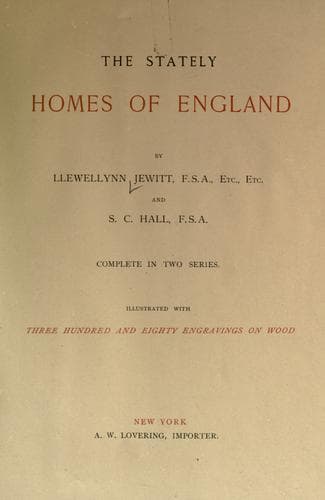
The Stately Homes of EnglandJewitt, Llewellynn Frederick William
History
The Stately Homes of England
Jewitt, Llewellynn Frederick William
Historic buildings -- England
The church at Penshurst is dedicated to St. John the Baptist. It
immediately adjoins the park, and is connected, by a private walk,
with the gardens of the mansion. It is an ancient and very venerable
structure, containing many monuments to the Sidneys, and to members of
the families of Dragnowt, Cambridge, Egerton, Head, Darkenol, Pawle,
and Yden. The most interesting and beautifully wrought of the tombs is
to the memory of Sir William Sidney, Knight Banneret, Chamberlain and
Steward to Edward VI., and Lord of the Manor of Penshurst, who died
in 1553. It stands in a small chapel at the west end of the chancel,
and at the foot of the tomb is a very antique figure, carved in
marble, supposed to be a memorial to Sir Stephen de Pencestre. Below
is the vault which contains the dust of generations of the Sidneys.
Sir William Sidney’s monument is a fine example of art, elaborately
and delicately sculptured; it contains a long inscription, engraved
on a brass tablet, the lettering in which is as clear and as sharp
as if it were the work of yesterday. The roof of this chapel is
peculiarly light and elegant. In both exterior and interior it is
highly picturesque. The oak gallery is one of the earliest erections
of the kind that followed the Reformation. Mr. Parker, in his address
to the Archæological Society, thus spoke of the church:—“It exhibited
specimens of the architecture of various periods, and is interesting as
the burial-place of the ancient families that inhabited the mansion.
The north side was of the time of Henry III., and was probably built by
Sir Stephen Penchester; the south side in the time of Edward III. The
chancel chapel at the end of the south aisle was the burial-place of
the Pulteney family. There were also two chantry chapels on the north
side, one of the time of Edward I., and the other of the time of Henry
VI. Amongst the other interesting monuments and tablets there is one
commemorative of the late illustrious Lord Hardinge.”
In all respects, therefore, a visit to PENSHURST—now by railroad
within an hour’s distance of the metropolis—may be described as a
rare intellectual treat, opening a full and brilliant page of history,
abundant in sources of profitable enjoyment to the antiquary, affording
a large recompense to the lover or the professor of Art, and exhibiting
nature under a vast variety of aspects.[32]
WARWICK CASTLE.
Public-domain text, read in full here on John Shaqi.
Reviews
Reviews
No reviews yet
Be the first to share your thoughts on this work.
Elsewhere in the archive
Join the Discussion
Join the discussion
Sign in to leave a comment or review.
Sign InorCreate an account