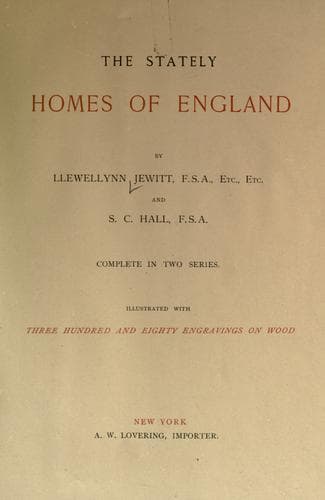
The Stately Homes of EnglandJewitt, Llewellynn Frederick William
History
The Stately Homes of England
Jewitt, Llewellynn Frederick William
Historic buildings -- England
WARWICK CASTLE holds foremost rank among the Stately Homes of England,
both from its historical associations, and the important positions
which, in every age, its lords have occupied in the annals of our
country. Situated in one of the most romantic and beautiful districts
of a fertile and productive shire, overlooking the “sweet-flowing
Avon,” and retaining all its characteristics of former strength and
grandeur, Warwick Castle is renowned among the most interesting
remains of which the kingdom can boast. Of its original foundation,
like that of other of our older strongholds, nothing is really known,
although much is surmised. It is said to have been a Celtic settlement,
converted into a fortress by the Roman invaders. However this may
be—and there were several ancient British and Roman roads and stations
in the county—it is not our purpose to inquire. It will suffice to
say that at the time of the Roman conquest of Warwickshire, which is
said to have occurred about the year 50, the county was occupied by
two tribes of ancient Britons, the Cornavii and Dobuni, the boundary
between these territories being, it would seem, the river Avon. Near
the Avon, relics of frontier fortresses on either side have—as at
Brownsover, Brailes, Burton Dassett, Brinklow, &c.,—been found; the
principal British and Roman roads being the Icknield Street, the
Fosse Way, and Watling Street. Warwick is believed, and not without
reason, to have been one of these frontier fortresses; its situation
would seem to lend strength to the supposition. In Anglo-Saxon
times, Warwick formed a part of the kingdom of Mercia, the capital
of which was at Repton, in the neighbouring county of Derby. At that
period it “fell under the dominion of Warremund, who rebuilt it,
and called it Warrewyke, after his own name.” Having been taken and
destroyed by the Danes, it “so rested,” says Dugdale, “until the
renowned Lady Ethelfled, daughter to King Alfred—who had the whole
earldom of Mercia given her by her father to the noble Etheldred in
marriage—repaired its ruins, and in the year of Christ DCCCCXV made a
strong fortification here, called the dungeon, for resistance of the
enemy, upon a hill of earth, artificially raised near the river side;”
and this formed the nucleus of the present building. In 1016 it is
stated to have again suffered from an attack by the Danes, who nearly
demolished the fortifications of the castle and did great damage to the
town. At the time of making the Domesday survey, Warwick was a royal
burgh, and “contained 261 houses, and with its castle was regarded as
a place of much consequence; for orders were issued by the Conqueror
to Turchel to repair and fortify the town and castle of Warwick.
This was carried into effect, by surrounding the town with a strong
wall and ditch, and by enlarging the castle and strengthening its
fortifications.”
Public-domain text, read in full here on John Shaqi.
Reviews
Reviews
No reviews yet
Be the first to share your thoughts on this work.
Elsewhere in the archive
Join the Discussion
Join the discussion
Sign in to leave a comment or review.
Sign InorCreate an account