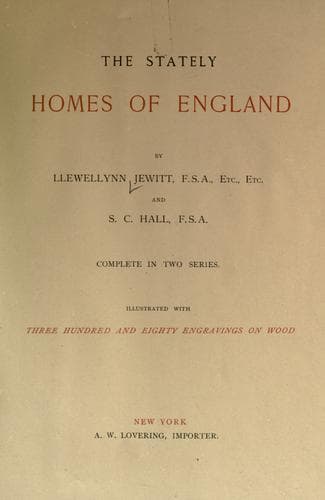
The Stately Homes of EnglandJewitt, Llewellynn Frederick William
History
The Stately Homes of England
Jewitt, Llewellynn Frederick William
Historic buildings -- England
In 1172 (19th Henry II.), Warwick Castle was provisioned and garrisoned
at an expense of £10 (which would be equivalent to about £200 of our
present money), on behalf of the king; and during those troublous times
it remained about three years in his hands. In 1173 a sum equal to
about £500 of our money was paid to the soldiers in the castle; and
in the following year, the building requiring considerable repair,
about £50 was laid out upon it, and a considerable sum was paid to
the soldiers who defended it for the king. In 1191 it was again
repaired, and also in the reign of King John. In the 48th of Henry
III. (1263), William Mauduit, Earl of Warwick, was surprised by the
adherents of Simon de Montfort, then holding Kenilworth, and the walls
of the castle were completely destroyed; indeed, so complete was the
devastation, that in 1315 “it was returned in an inquisition as worth
nothing excepting the herbage in the ditches, valued at 6_s._ 8_d._”
In 1337 (12th Edward III.) a new building was commenced, and in that
year a royal licence was granted for the founding of a chantry chapel
in the castle. The building was commenced by Thomas Beauchamp, Earl
of Warwick, whose monument is preserved in the Beauchamp Chapel. In
1394 (17th Richard II.) Guy’s Tower is said to have been completed by
Thomas Beauchamp, second son of the last named Thomas, at a cost of
£395 5_s._ 2_d._, and by him to have been named “Guy’s Tower.” In the
reign of James I. a sum of about £20,000 was expended by the then owner
of the castle, Fulke Greville, Lord Broke, “in making it habitable and
restoring it to its former importance.” From this time downwards, the
castle has undergone many alterations, and so-called “beautifyings,” at
the hands of its different owners; but, despite all, it retained its
ancient grandeur and its most interesting features, and was, as Sir
Walter Scott has said, “the fairest monument of ancient and chivalrous
splendour which remains uninjured by time.”
[Illustration: _The Castle, from the Temple Field._]
And now as to its long line of illustrious and valiant owners.
Public-domain text, read in full here on John Shaqi.
Reviews
Reviews
No reviews yet
Be the first to share your thoughts on this work.
Elsewhere in the archive
Join the Discussion
Join the discussion
Sign in to leave a comment or review.
Sign InorCreate an account