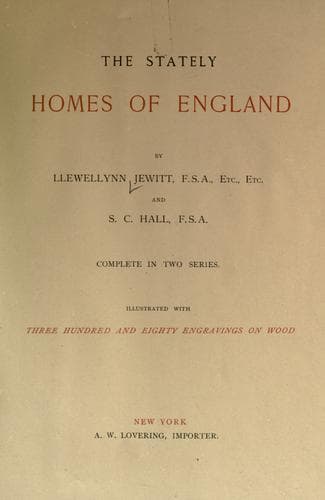
The Stately Homes of EnglandJewitt, Llewellynn Frederick William
History
The Stately Homes of England
Jewitt, Llewellynn Frederick William
Historic buildings -- England
The castle having been strengthened and enlarged, its custody was given
to Henry de Newburgh, a Norman, who had accompanied the Conqueror,
and to him was afterwards granted all the possessions of Turchel de
Warwick, and he was made Earl of Warwick. By some he is said to have
married the daughter of Turchel, but he is also stated to have married
three other ladies. He was succeeded by his son, Roger Newburgh, as
second Earl of Warwick, who married Gundred, daughter of the second
Earl Warren, by whom he had a son, William, who succeeded him as third
earl, and dying without issue, was succeeded by his brother Walleran
as fourth earl, who married twice—first, Margaret de Bohun, and
second, Alice de Harcourt. By his first wife he had two sons, Henry,
who succeeded him, and Walleran. Henry de Newburgh, fifth Earl of
Warwick, was a minor at his father’s death in 1205, and was placed
under Thomas Bassett, of Headington, near Oxford. In the thirteenth
year of King John, he was certified as holding 107 knights’ fees of the
king _in capite_. Having led an active military life, and married two
wives—Margaret D’Oyley and Philippa Bassett—he died 1229, and was
succeeded as sixth earl by his son, Thomas de Newburgh.
[Illustration: _The Keep, from the Inner Court._]
This nobleman married a daughter of the Earl of Salisbury, but died
without issue. His sister and heiress, Margery, who was married to
John de Mareschal, brother to the Earl of Pembroke, succeeded to the
estates, and her husband became seventh earl. This honour he did not
enjoy long, but died without issue “within about half a year of his
brother-in-law the late earl.” The widow then, by special arrangement
of Henry III., married John de Placetis, or Plessitis, a Norman by
birth, and a great favourite of the king. By the Countess of Warwick
he had no issue, and therefore at her death the estates passed to her
cousin, William Mauduit, Baron of Hanslape, who died without issue.
The title and estates then at his death passed to his sister, Isabel
Mauduit, wife of William de Beauchamp, heir of Walter de Beauchamp,
Baron of Elmley, who thus through her became heir to the title, which
however,—she having entered a nunnery,—was not claimed, but passed,
in the person of their son William, into the powerful family of
Beauchamp. By Isabel Mauduit William de Beauchamp the elder had four
sons—William, who succeeded him; John, whose grandson was created
Baron Beauchamp; Walter, ancestor of Fulke Greville, Lord Broke; and
Thomas, who died unmarried. William de Beauchamp, who bore the title
of Earl of Warwick during his father’s lifetime, married Maud, one
of the co-heiresses of Richard Fitzjohn, by whom he had issue with
others, Guy de Beauchamp, who succeeded him as Earl of Warwick. This
Guy, so called, no doubt, after the “renowned Guy,” attended the
king into Scotland, and for his valour at the battle of Falkirk, had
granted to him all the lands of Geoffrey de Mowbray in that kingdom,
Public-domain text, read in full here on John Shaqi.
Reviews
Reviews
No reviews yet
Be the first to share your thoughts on this work.
Elsewhere in the archive
Join the Discussion
Join the discussion
Sign in to leave a comment or review.
Sign InorCreate an account