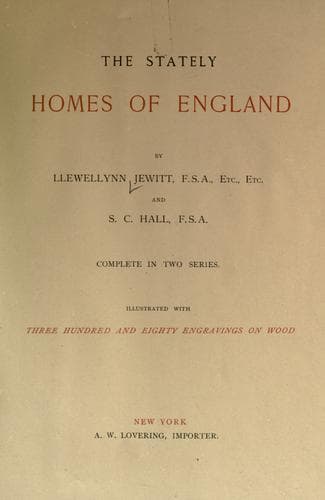
The Stately Homes of EnglandJewitt, Llewellynn Frederick William
History
The Stately Homes of England
Jewitt, Llewellynn Frederick William
Historic buildings -- England
with the exception of Okeford, and all the lands of John de Strivelin,
with the castle of Amesfield, and the lands of Drungery. He was one
of the noblemen who seized Piers Gaveston,—against whom he held a
mortal hatred for having called him “the black hound of Arden,”—whom
he conveyed to Warwick Castle, from whence he was removed to Blacklow
Hill, near Warwick, and beheaded. This Guy married Alice, sister and
heiress to Robert de Toni, Baron of Flamstead, and widow of Thomas de
Leybourne, and by her had issue two sons and five daughters. He died
(it was suspected by poison) in 1315, and was succeeded by his eldest
son, Thomas de Beauchamp, who married Catherine Mortimer, daughter of
the Earl of March, by whom he had issue seven sons and ten daughters.
The sons were—Sir Guy, “a stout soldier,” who died in his father’s
lifetime, leaving three daughters, all nuns, at Shouldham; Thomas, his
successor; Reynbourne, so called in memory of the son of the “renowned
Guy;” William, who became Lord Abergavenny; Roger, John, and Jerome.
[Illustration]
Thomas Beauchamp, the eldest son, who succeeded to the honours, was
knighted in the lifetime of his father. He, like his predecessor, made
many additions to the castle, the principal of which was the building
of Guy’s Tower. Having passed a troublous life, being at one time
confined and condemned in the Tower of London, he died in 1401, leaving
by his wife Margaret, daughter of Lord Ferrars of Groby, two daughters,
nuns, and one son, Richard Beauchamp, who succeeded him. This Richard,
Earl of Warwick, is said to “have surpassed even the great valour and
reputation of his ancestors;” and, indeed, his career seems altogether
to have been one of the most brilliant and successful on record; and
besides having a special herald of his own, “Warwick Herald,” he was
styled the “Father of Courtesye.” “He founded the Chantry of Guy’s
Cliff, where before this foundation were Guy’s Chappel and Cottage.”
In this he placed the statue of Guy (still seen, though much defaced),
made several pious donations, and died at Roan in the 17th of Henry VI.
There is extant a very remarkable and curious MS. Life of this renowned
warrior; it is preserved in the British Museum (Julius, E. IV.).
In it the illuminations are very spirited, and are highly valuable
as examples of armour, &c., of the time, no less than as genuine
representations of various valiant deeds in which he was engaged.
[Illustration]
Public-domain text, read in full here on John Shaqi.
Reviews
Reviews
No reviews yet
Be the first to share your thoughts on this work.
Elsewhere in the archive
Join the Discussion
Join the discussion
Sign in to leave a comment or review.
Sign InorCreate an account