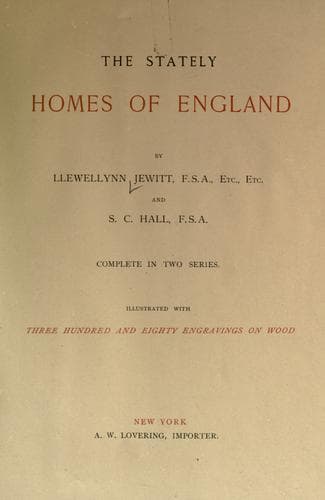
The Stately Homes of EnglandJewitt, Llewellynn Frederick William
History
The Stately Homes of England
Jewitt, Llewellynn Frederick William
Historic buildings -- England
Having thus glanced at the history of the place, and spoken of the
long line of noble and illustrious owners, both of the estates and the
title, let us turn to the castle itself, as it stood and was furnished,
at the time of our visit. Alas! that we should have to write this in
a past sense, and say “stood” in place of “stands.” Alas! that within
a few short weeks of our visit, and of our writing these notes, a
great part of the building was “gutted” by fire, and many of its
most important and interesting features destroyed. It is, however,
being rapidly and wisely restored, and doubtless will, ere long, rise
“phœnix-like” from the ashes, with renewed beauty. We give our notes as
we wrote them before this calamity occurred.
THE Castle occupies the summit of a steep hill, which must greatly have
aided its artificial defences in the “olden time.” The present approach
to it is by a narrow passage cut through the solid rock, and extending
from the main entrance to the porter’s lodge fronting the road to
Leamington. Passing through this lodge, the visitor, after proceeding
some distance along the rocky passages, enters the outer court-yard,
“where the stupendous line of fortifications breaks suddenly upon the
sight in all its bold magnificence.” Of the two famous towers that
of Guy is on the right, while that of Cæsar is on the left; they are
connected by a strong embattled wall, in the centre of which is the
ponderous arched gateway, flanked by towers, and succeeded by a second
arched gateway, with towers and battlements, “formerly defended by two
portholes, one of which still remains; before the whole is a disused
moat, with an arch thrown over it at the gateway, where was once a
drawbridge.” Passing the double gateway the court-yard is entered. Thus
seen, the castellated mansion of the most famous of the feudal barons
has a tranquil and peaceful aspect; fronting it is a green sward and
the “frowning keep,” which conceals all its gloomier features behind a
screen of ivy and evergreen shrubs. Uninjured by time, and unaltered in
appearance by modern improvements, except in being surrounded and made
picturesque by trees and shrubs, it still stands, as of old, on the top
of its mound. The “Bear Tower,” with a flight of steps descending to a
subterranean passage, leading no one knows whither, will be noticed, as
also will “Guy’s Tower.”
Public-domain text, read in full here on John Shaqi.
Reviews
Reviews
No reviews yet
Be the first to share your thoughts on this work.
Elsewhere in the archive
Join the Discussion
Join the discussion
Sign in to leave a comment or review.
Sign InorCreate an account