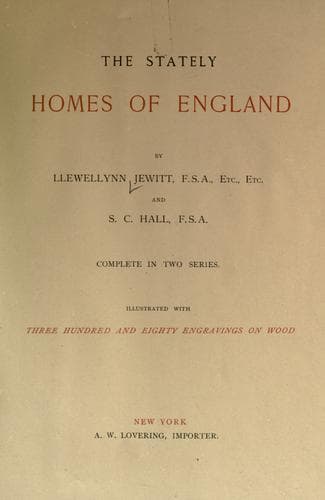
The Stately Homes of EnglandJewitt, Llewellynn Frederick William
History
The Stately Homes of England
Jewitt, Llewellynn Frederick William
Historic buildings -- England
From the inner court a flight of stone steps leads to the entrance to
the GREAT HALL, which is of large size; its walls are decorated with
arms and armour of various periods and descriptions, and with antlers
and other appropriate objects. On one side of this hall are the state
rooms, and on the other the domestic apartments, forming a line of
333 feet in length. The Hall, and indeed the whole of the interior,
have been “subjected to the deleterious influence of the upholsterer,”
and are made gorgeous and beautiful in accordance with modern
taste, while they have lost their original features and interesting
characteristics. This work was, however, done some time ago, and
it must remain as it is: comfort and convenience have been studied
certainly; but all associations with the glory of ancient Warwick were
rejected by the modern architect in his restoration of the apartments
of the venerable castle. In the hall, however, there are many objects
of rare interest; among others the helmet studded with brass worn
by the Protector Cromwell; the suit of armour worn by Montrose; the
doublet, “blood-spotted,” in which Lord Broke was slain at Lichfield,
in 1643; and the warder’s horn, the history of which is told in this
inscription:—
PHIL · THOMASSINUS · FEC · ET · EXCUD · CUM · PRIVIL · SUMMI ·
PONTIFICES · ET · SUPERIOR : LICENTIA · ROMÆ · FLORUIT · 1598.
There is also a breech-loading revolving musket, some hundreds of years
old probably, which, but for the evidence of Time, might seem a direct
plagiarism on the revolver of Colonel Colt. The roof of the hall was
designed by the architect Poynter.
[Illustration]
The RED DRAWING-ROOM contains many fine paintings and several articles
of _vertu_.
The CEDAR DRAWING-ROOM is a remarkably elegant apartment, sumptuously
furnished, and having a magnificent and, said to be, unique chimney
piece. In this room are many remarkably fine paintings, including
“Charles I.,” by Vandyck; “Circe,” by Guido; the “Family of Charles
I.,” &c.; and some highly interesting bronzes, Etruscan vases, &c. The
main feature of—
The GILT DRAWING-ROOM is its superb geometric ceiling, which is richly
painted and gilt—the walls being decorated in a corresponding manner.
Among the paintings in this room may be noted the “Earl of Strafford,”
by Vandyck; “Algernon Percy,” by Dodson; “Charles I.,” “Henrietta
Maria,” and “Prince Rupert,” by Vandyck; “Ignatius Loyola,” by Rubens;
“Robert Bertie, Earl of Lindsay,” by Cornelius Jansen; “Robert Rich,
Earl of Warwick,” after Vandyck; a “Young Girl,” by Murillo; “Robert
Dudley, Earl of Leicester,” and many others.
Public-domain text, read in full here on John Shaqi.
Reviews
Reviews
No reviews yet
Be the first to share your thoughts on this work.
Elsewhere in the archive
Join the Discussion
Join the discussion
Sign in to leave a comment or review.
Sign InorCreate an account