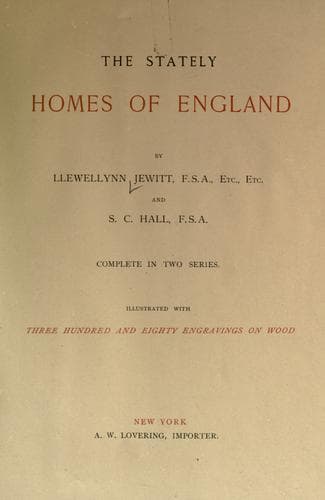
The Stately Homes of EnglandJewitt, Llewellynn Frederick William
History
The Stately Homes of England
Jewitt, Llewellynn Frederick William
Historic buildings -- England
In the PORTER’S LODGE are preserved a number of relics, said to have
belonged to the “Renowned Guy”—but, as they represent so many periods,
they must have appertained to “Many Guys.” The articles shown are
“Guy’s Porridge-pot;” “Guy’s Sword,” for taking care of which William
Hoggeson, Yeoman of the Buttery, had a salary of 2_d._ a day, temp. H.
VIII.; parts of his armour, of which the “bascinet is of the time of
Edward III.; and a breastplate partly of the fifteenth century, and
partly of the time of James I.; the sword of the reign of Henry VIII.;
the staff, an ancient tilting lance;” the horse armour of the fifteenth
century; the “flesh fork;” and other articles, among which are his
fair “Felicia’s slippers,” which are a pair of footed stirrup-irons of
the fifteenth century. The “rib of the dun cow,” and a joint of the
spine of the same, as well as the tusk and blade bone of a wild boar,
are also shown, and are still looked upon with wonder, as belonging
to veritable animals slain by Guy. There are also other “curiosities”
shown in this lodge, and visitors eagerly inspect them, often as
greater attractions than matters more worthy. Into the wild old legend
connected with Guy, Earl of Warwick, it is not necessary here to
enter at length. It was a popular legend in the Middle Ages, and his
encounter with the Danish champion, Colbrand, as well as his victory
over the dun cow, was a favourite subject of the wandering minstrel.
Dugdale has given the narrative of his battle with Colbrand, which he
seems inclined to believe to be true in the main features, although
“the monks may have sounded out his praises hyperbolically.” According
to him, “in year three of King Athelstan, A.D. 826, the Danes having
invaded England, cruelly wasted the countrys where they marcht, so that
there was scarce a town or castle that they had not burnt or destroyed
almost as far as Winchester,” where the king resided, and to whom they
sent a message, requiring him to resign his crown to their generals,
holding his power at their hands, and paying them yearly tribute for
the privilege of ruling; or that the whole dispute for the kingdom be
determined in a single combat, by two champions for both sides. The
king having chosen the latter alternative, enjoins a fast for three
days, and, in great anguish of heart that Guy the famous warrior is
absent on a pilgrimage to the Holy Land, prays Heaven for assistance.
An angel appears to the king as he is on his bed, and directs him to
arise early on the morrow, and take two bishops with him to the north
gate of the city, and stay there “till the hour of prime,” until the
poor people and pilgrims arrive, among whom he must choose a champion,
and the choice must fall upon him who goes barefooted, with a wreath of
white roses on his head. The king goes and meets the pilgrim, accosts
him, and asks his championship, which he hesitates to give, excusing
himself on the ground of his weakness with much travel, and exhorts
Public-domain text, read in full here on John Shaqi.
Reviews
Reviews
No reviews yet
Be the first to share your thoughts on this work.
Elsewhere in the archive
Join the Discussion
Join the discussion
Sign in to leave a comment or review.
Sign InorCreate an account