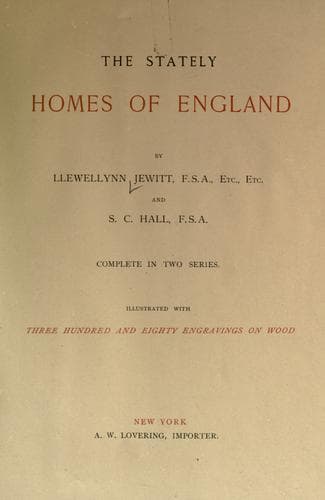
The Stately Homes of EnglandJewitt, Llewellynn Frederick William
History
The Stately Homes of England
Jewitt, Llewellynn Frederick William
Historic buildings -- England
him to seek fitter help. To this the king bitterly answers, “I had but
one valiant knight, which was Earl of Warwick, called Guy, and he had
a courageous servant, named Sir Heraud de Ardene; would to God I had
him here, for then should this duel be soon undertaken, and the war
finished; and as he spake these words, the tears fell from his eyes.”
[Illustration: _The Castle, from the banks of the Avon._]
The pilgrim is moved, and ultimately consents, and after three weeks
spent in prayer and preparation the battle begins. Colbrand “came so
weightily harnessed, that his horse could scarcely carry him, and
before him a cart loaded with Danish axes, great clubs, with knobs
of iron, squared bars of steel, lances, and iron hooks, to pull his
adversary to him.” The giant uses a bar of steel in the combat, which
lasts the whole day. Guy in the end proving victorious, and taking
a farewell of the king, to whom he declares himself, goes towards
Warwick, and thence to a hermit in its neighbourhood, living with
him till his death, and succeeding him in his cell until his own
decease.[34] The spot is still pointed out, and bears the name of
Guy’s Cliff. But this is not the only giant-story connected with the
family. Their well-known crest, or cognisance, is said to come from one
Morvidus, an Earl of Warwick in the days of King Arthur, “who being
a man of valour, slew a mighty gyant in a single duell, which gyant
encountered him with a young tree pulled up by the root, the boughs
being nog’d from it; in token whereof, he and his successors, Earles
of Warwick in the time of the Brittons, bore a ragged staff of silver
in a sable shield for their cognisance.” Other stories are the combat
and overcoming of the famous dun cow, the slaying of a ferocious lion,
and “the greatest boar that man e’er saw,” the killing of “the mighty
dragon in Northumberland that destroyed men, women, and children,” and
the killing of the fifteen armed knights. Such were the old fables with
which our ancient family histories were obscured, or rendered romantic
and wonderful to the subordinate classes.
Public-domain text, read in full here on John Shaqi.
Reviews
Reviews
No reviews yet
Be the first to share your thoughts on this work.
Elsewhere in the archive
Join the Discussion
Join the discussion
Sign in to leave a comment or review.
Sign InorCreate an account