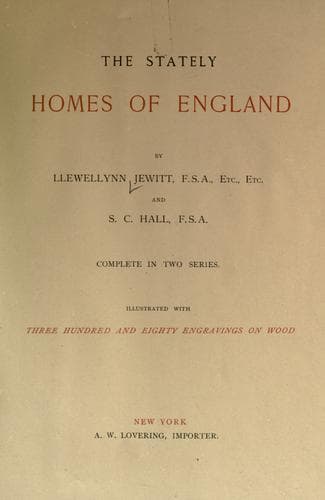
The Stately Homes of EnglandJewitt, Llewellynn Frederick William
History
The Stately Homes of England
Jewitt, Llewellynn Frederick William
Historic buildings -- England
The Duke, who was familiarly known as “the old man of the hill,” dying
in 1779, was succeeded by his grandson, Charles Manners, son of the
celebrated Marquis of Granby, Commander-in-chief of the British forces
in Germany, and Master of the Ordnance, who died during his father’s
lifetime. Charles, fourth Duke of Rutland, married Mary Isabella,
daughter of Charles Noel, Duke of Beaufort, by whom he had issue four
sons—viz., John Henry, who succeeded him, Charles Henry Somerset,
Robert William, and William Robert Albini; and two daughters—viz.,
the Lady Elizabeth Isabella, married to Richard Norman, Esq., and
Lady Catherine Mary, married to Lord Forester. His grace died while
holding office as Lord-Lieutenant of Ireland, and was succeeded by his
eldest son—John Henry Manners, as fifth Duke of Rutland, who married
Elizabeth, daughter of the Earl of Carlisle, and by her had issue,
among others, his grace the present Duke of Rutland (third son, the two
elder ones having died before their father), and Lord John Manners,
M.P. His grace died in 1857, aged seventy-nine.
The present peer, Charles Cecil Manners, sixth Duke of Rutland, Marquis
of Granby, Earl of Rutland, and Baron Manners of Haddon, &c., &c., was
born in 1815, and has held many important appointments. His grace is
not married: the heir to the title and estates being his brother, Lord
John Robert Manners (Marquis of Granby, by courtesy), M.P. for North
Leicestershire, who is also known for the official posts he has held in
the government of this country.
[Illustration]
The arms of the Duke of Rutland are, _or_, two bars, _azure_; augmented
by a chief, quarterly, first and fourth _azure_, two _fleurs-de-lis_,
_or_ (France), second and third _gules_, a lion _passant-guardant_,
_or_ (England). Crest, on a _chapeau_, _gules_, turned up, _ermine_, a
peacock in pride, proper. Supporters, two unicorns, _argent_, horns,
manes, tufts, and hoofs, _or_. Motto, “Pour y parvenir.”
The meadows around Haddon—with the river Wye twisting and turning
about in all imaginable forms—are very delightful, and some of the
pleasantest strolls conceivable may be taken along them, both up and
down the stream, which is full of fine trout, and is, therefore, a
source of endless delight to the angler.
Having thus given our readers as full an account as would appear
necessary both of the noble families to whom Haddon has belonged,
and of the Hall itself, and told them as much of its history as is
requisite for our purpose, we take leave of this interesting pile, and
proceed to speak of one or two matters connected with its immediate
neighbourhood, before passing on to the fine old church at Bakewell,
where lie interred so many of the families of Vernon and Manners.
Public-domain text, read in full here on John Shaqi.
Reviews
Reviews
No reviews yet
Be the first to share your thoughts on this work.
Elsewhere in the archive
Join the Discussion
Join the discussion
Sign in to leave a comment or review.
Sign InorCreate an account