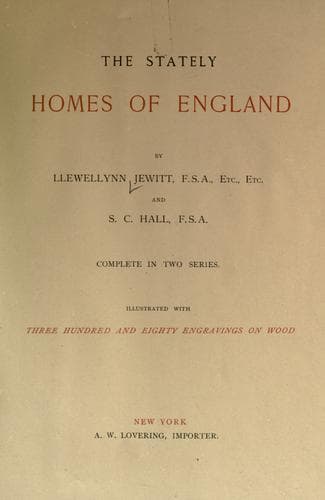
The Stately Homes of EnglandJewitt, Llewellynn Frederick William
History
The Stately Homes of England
Jewitt, Llewellynn Frederick William
Historic buildings -- England
Haddon has been a prolific theme for writers, and an endless source of
inspiration for poets and artists, and long will it continue to be so,
for no “olden” place can be more picturesque or more romantic. It is
said that Mrs. Radcliffe was so struck with it, that she laid the scene
of her “Mysteries of Udolpho” here; and Allan Cunningham, the Countess
de Carabrella, and numberless other writers, have made it a theme for
some of their pleasantest productions; William Bennett took it and
its hospitable owner, Sir George Vernon, as the subject of one of his
most successful novels, “The King of the Peak;” while D. Cox, Nash,
Cattermole, Harding, Rayner, Morrison, and a host of other artists,
have added to their reputations by painting some of its more attractive
features.
[Illustration: _The Foot-Bridge._]
As may naturally be expected, in a neighbourhood so rich in interest
as that of Haddon, some singular discoveries have at one time or other
been made. Among these the Roman altar, described on a preceding page,
is perhaps the most important.
The opening of barrows in the neighbourhood has brought to light
many interesting remains of the ancient British period, and also of
Romano-British times. These consist of interments in which have been
found cinerary urns, drinking-cups, bone mesh-rules, flint implements,
bronze celts, and other articles.
Some fine antlers, and parts of antlers, of the red deer, one of which,
with four points at the top, measured more than three feet along its
outer curve, and was six-and-a-half inches in medium circumference,
have also been found. But these are not the only remains of extinct
animals found in the neighbourhood, for those of the wild dog, the wild
hog, the horse, the deer, the roebuck, and the ox—both the _Bos urus_
and the _Bos longifrons_—all of which once ran wild in Derbyshire,
have been found, in the course of deep draining near the Hall, and
preserved under the careful direction of Mr. Nesfield.
[Illustration: _Ring found at Haddon Hall._]
Perhaps the most elegant relic yet discovered is the ring shown
in our engraving, which is in possession of his Grace the Duke of
Rutland. It was found a few years ago, not far from the “Bowling
Green,” and is evidently of the fifteenth century, and is of extremely
fine workmanship and elegant design. The hoop is wreathed, and
has originally been enamelled, and bears between the foliage the
inscription, in old English letters, “de boen cuer,” which is one
of frequent occurrence as a posy upon mediæval rings, probably in
this case, meaning _de bon cœur_, and showing the hearty affection
of the giver to the receiver. The little figure engraved on the
besel is St. John the Baptist, with the Lamb enfolded in his mantle,
and has most likely also been enamelled. It is probably a kind of
charm-ring—_i.e._, a ring possessing physical or phylacteric qualities
against epilepsy, the _mal de St. Jean_. It is of the purest gold, and
weighs ninety-seven grains.
Public-domain text, read in full here on John Shaqi.
Reviews
Reviews
No reviews yet
Be the first to share your thoughts on this work.
Elsewhere in the archive
Join the Discussion
Join the discussion
Sign in to leave a comment or review.
Sign InorCreate an account