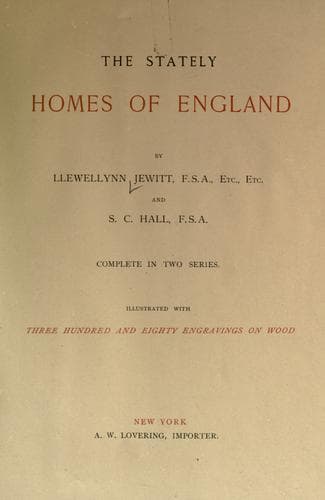
The Stately Homes of EnglandJewitt, Llewellynn Frederick William
History
The Stately Homes of England
Jewitt, Llewellynn Frederick William
Historic buildings -- England
This cornet and frieze surmount a semicircular arch, beneath which
are the kneeling figures, facing each other, of Sir John Manners, in
plate armour, and his wife, Dorothy Vernon, in close-fitting dress,
with cap, and frill or ruff around the neck. Between them there is
a pedestal, bearing the following incription:—“Here lyeth S^r John
Manners, of Haddon, Knight, second sonne of Thoas, Erle of Rutland, who
dyed the 4 of June, 1611, and Dorothie his wife, one of the daughters
and heires to S^r George Vernon, of Haddon, Knight, who deceased the 24
day of June, in the 26 yere of the raigne of Queen Elizabeth, 1584.”
Above the pedestal is a large shield, with quarterings of the armorial
bearings of the families of Manners and Vernon and their alliances;
the shields bearing the sixteen quarterings of Manners, differenced
with a crescent, impaled with the twelve quarterings of Vernon. On the
spandrels are also shields of arms, the one bearing Manners quartering
Roos and two others; and the other, Vernon quartering Avenel and two
others. The lower part of the monument contains four figures of the
children of Sir John and his wife Dorothy, and two shields, the one
bearing the arms of Manners, and the other those of Vernon.
At the opposite or north end of the chapel is a much larger and more
pretentious monument, that of Sir George Manners, son and heir of Sir
John Manners and Dorothy Vernon, and of his wife, Grace Pierrepoint.
At the top is a large shield bearing the arms of Manners with its
sixteen quarterings, and on each side is an obelisk. Beneath these is
a massive and bold cornice, supported on Corinthian pillars, forming a
recess in which is a semicircular arch, elaborately carved, and over
it the inscription, “The day of a man’s death is better than the day
of his birth.” Under this arch and cornice are the effigies of Sir
George Manners and his wife, kneeling, and facing each other, while
between them is a double desk, or lectern, on the front of which are
the words—“Thy prayers and thine alms are gone up before thee,” and
a shield bearing the arms of Manners impaling Pierrepoint. Behind the
figures, on a tablet, is a Latin inscription, which has been thus
translated:—“Sir George Manners of Haddon, Knt., here waits the
resurrection of the just in Christ. He married Grace, second daughter
of Sir Henry Pierrepoint, Knt., who afterwards bore to him four sons
and five daughters, and lived with him in holy wedlock thirty years.
She caused him to be buried with his forefathers, and then placed this
monument, at her own expense, as a perpetual memorial of their conjugal
faith, and she joined the figure of his body with hers, having vowed
their ashes and bones should be laid together. He died 23rd April,
1623, aged 54. She died ——.” Sir George is represented in armour,
and his lady is habited in close dress, with ruff, hood or coif, and
long veil. Beneath the figures of the knight and his lady, the monument
Public-domain text, read in full here on John Shaqi.
Reviews
Reviews
No reviews yet
Be the first to share your thoughts on this work.
Elsewhere in the archive
Join the Discussion
Join the discussion
Sign in to leave a comment or review.
Sign InorCreate an account