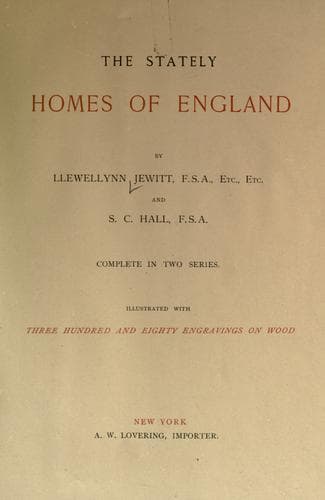
The Stately Homes of EnglandJewitt, Llewellynn Frederick William
History
The Stately Homes of England
Jewitt, Llewellynn Frederick William
Historic buildings -- England
is divided into two heights, each of which is formed into an arcade
holding the effigies of their children. The upper arcade consists
of four semicircular arches, with shields of armorial bearings in
the spandrels. Within the first of these arches is the effigy of the
eldest son—a “chrisom child”—who died in infancy and is, as usual,
represented bound up, mummy fashion, in swaddling-clothes; in the
second, the kneeling effigy, in armour, of John Manners, who ultimately
succeeded to the title of eighth Earl of Rutland; and in the third
and fourth, those of two of the daughters. In the lower arcade, which
is formed of five archways, the first two being semicircular and the
remaining three pointed, are respectively the kneeling effigies of
Henry Manners, who died at the age of fourteen, and is habited as a
youth; Roger Manners, in armour; and three daughters. In the spandrels
of the arches, as in the upper arcade, are a series of shields with
armorial bearings. Over the nine arches are the nine inscriptions as
follows:—Over the “chrisom child,” “Mine age is nothing in respect
of thee;” over the son and heir, “One generation passeth and another
cometh;” over the youth, Henry Manners, “My days were but a span long;”
over the fourth son, Roger, “By the grace of God I am what I am;” over
the daughters, beginning with the eldest, “A virtuous woman is a crown
to her husband,” “The wise woman buildeth her house,” “A gracious woman
retaineth honour,” “A prudent wife is from the Lord,” and “She that
feareth the Lord shall be praised.” On the pedestal by Sir George,
“Christ is to me both in death and life an advantage,” and on the
opposite one, by his wife, “I shall go to him, he shall not return to
me.” The arms on the shields are those of Manners, differenced with
a crescent; Pierrepoint; Manners impaling Montague; Sutton impaling
Manners; Howard impaling Manners; and the other alliances also impaled.
On the wall is a memorial to John Manners, son of Dorothy Vernon and
her husband, Sir John Manners, with the inscription—“Heare lieth
buried John Manners, gentleman, third son of S^r John Manners, Knight,
who died the xvi day of July, in the yeere of our Lord God 1590, being
of the age of 14 yeers.”
The most ancient, and certainly one of the most interesting, monuments
in the church, is that of Sir Thomas de Wendesley, or Wensley, of
Wensley, who was killed at the battle of Shrewsbury in 1403. It is an
altar-tomb, with the recumbent effigy of the knight in plate armour,
wearing the conical helmet or bascinet, and camail or tippet of chain
mail, with gussets of the same at the arm-pits. His girdle, which is
exceedingly rich, encircles his hips; the sword is lost, but the dagger
remains. His surcoat is emblazoned with his arms, and he wears the
collar of SS. On the front of the helmet is inscribed IHO NAZAREN.
Public-domain text, read in full here on John Shaqi.
Reviews
Reviews
No reviews yet
Be the first to share your thoughts on this work.
Elsewhere in the archive
Join the Discussion
Join the discussion
Sign in to leave a comment or review.
Sign InorCreate an account