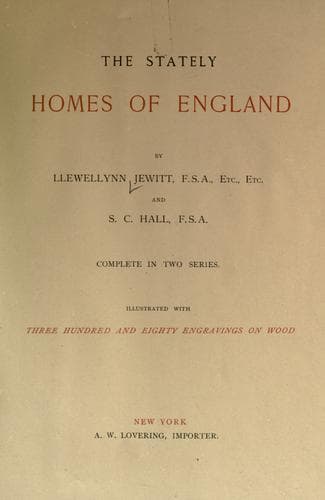
The Stately Homes of EnglandJewitt, Llewellynn Frederick William
History
The Stately Homes of England
Jewitt, Llewellynn Frederick William
Historic buildings -- England
hastily replaced, but with the face downwards. The rest of the body was
undisturbed. Several other bodies were, of course, found, as were some
few other interesting matters which require no notice here.
[Illustration: _Ancient Cross, Bakewell Churchyard._]
In the churchyard, near the east wall of the south transept, stands
one of the finest so-called “Runic crosses” in the kingdom. It is,
exclusive of the modern pedestal, about eight feet in height: the upper
limb of the cross is broken off. Of this fine old cross we give an
engraving. The front of the cross, which in bad taste has been turned
towards the wall, is sculptured in four heights, with figures beneath
arches—the upper group being the Crucifixion: the whole, however,
is much defaced. The opposite side, the one shown in our engraving,
is boldly sculptured, with a beautiful scroll-pattern of foliage
terminating at the top in an animal, and at the bottom is a cross
within a circle; on the head is a figure on horseback. The sides of
the cross are sculptured in scroll-work of foliage, of much the same
design as the side just described; the end of one of the limbs bears an
interlaced ornament, and the other a figure. This cross, and the one
at Eyam, a few miles distant, are among the most perfect and beautiful
remaining examples of the early period to which they belong.
If the tourist still wishes to linger for a few minutes in the
churchyard, he will find much to interest, to please, and to amuse him.
To _interest_ him in examining the external features of the church,
especially the Norman doorway and arcade, &c., at the west end, and the
beautiful doorway of Early-English design on the south side, as well as
the stone coffins grouped together in one corner. To _please_ him, in
the magnificent view he obtains of the surrounding country, especially
of the valley of the Wye as it runs its zig-zag course towards Haddon;
and to _amuse_ him, in reading the strange verses which occur on some
of the grave-stones which crowd around him on every side, and in the
church itself.
One of these, to the memory of a former parish clerk and leader of the
choir, reads as follows:—
“ERECTED TO THE MEMORY OF PHILIP ROE, WHO DIED 12TH SEPTEMBER, 1815,
AGED 52 YEARS.
“The vocal Powers, here let us mark,
Of PHILIP, our late Parish Clerk.
In church, none ever heard a Layman
With a clearer Voice say Amen!
Oh! who with Hallelujah’s Sound
Like Him can make the Roofs resound.
The Choir lament his Choral Tones,
The Town—so soon here lie his Bones.
Sleep undisturbed, within thy peaceful shrine,
Till angels wake thee with such tones as thine.”
Another long inscription to the memory of John Dale, barber-surgeon, of
Bakewell, and his two wives, Elizabeth Foljambe and Sarah Bloodworth,
1757, thus curiously ends:—
Public-domain text, read in full here on John Shaqi.
Reviews
Reviews
No reviews yet
Be the first to share your thoughts on this work.
Elsewhere in the archive
Join the Discussion
Join the discussion
Sign in to leave a comment or review.
Sign InorCreate an account