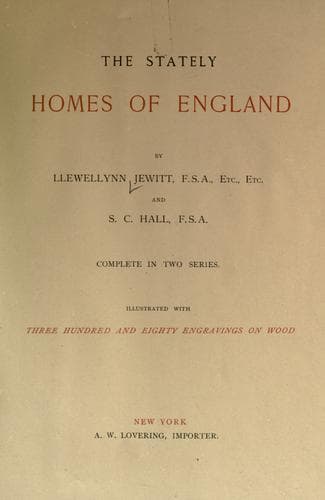
The Stately Homes of EnglandJewitt, Llewellynn Frederick William
History
The Stately Homes of England
Jewitt, Llewellynn Frederick William
Historic buildings -- England
In the chancel is an altar-tomb to John Vernon, 1477, the inscription
on which runs as follows:—“Hic jacet Johis Vernon filius et heres
Henrici Vernon qui obiit xii die mensis Augusti Anno Dni Mo cccclxxvii
cuj anime piciet̄ dē;” and in the Vernon Chapel is an incised slab,
with the arms of Eyre.
In the nave is a small but exceedingly beautiful monument bearing the
half-length effigies, side by side, under an elaborately-crocketed
canopy, of Sir Godfrey Foljambe and Avena his wife. The knight is
represented in armour, with conical helmet or bascinet, and tippet of
chain mail; his surcoat bearing the arms of Foljambe. The lady wears a
reticulated caul. In each of the spandrels is a shield, the one bearing
the arms of Foljambe, the other that of the family of Ireland, of
Hartshorne, to which the lady belonged.
There are several tablets and inscriptions in various parts of the
church which are worthy of a passing glance, and there are also some
memorial stained-glass windows of good design. Among these is one in
memory of the late Duke of Rutland, representing the Resurrection,
bearing the following inscription:—“The above window was erected,
by subscription, in memory of John Henry, Duke of Rutland, who died
20th January, 1857, aged seventy-nine years.” Others are put in to the
memory of the late Mr. Allcard and of Mr. Jonathan Wilson and others.
Before leaving the interior of this fine old church, it will, no doubt,
interest the visitor to be told in fewer words, and more correctly
than could be gleaned from the strange tales sometimes told in the
place, the story of the uncovering of the remains of Dorothy Vernon,
her husband, and other members of the family, during the rebuilding
and alteration of the church. When the excavations were commenced on
the site of the monument of Sir John Manners and his wife Dorothy
Vernon, the remains of two persons, supposed to be the knight and his
lady, were found; the skull of the one was identified as that of Sir
John, by its peculiar form and its likeness to his sculptured effigy;
that of the other, which lay near it, with beautiful auburn hair still
attached, among which were some pins that had been used to fasten
it—was naturally, and no doubt correctly, considered to be that of the
once lovely Dorothy. In another part three children’s leaden coffins
were found, but not opened, and the bones of an infant (probably the
“chrisom child,” represented on the tomb of Sir George Manners) were
discovered rolled up in a sheet of lead. These, no doubt, were the
children of different members of the Manners family. A leaden coffin
was also found which contained the body of a lady. The part of the lid
over the head had been violently torn away—the piece of the sheet of
lead being missing—and this was carefully and thoroughly examined. The
body had been buried in lime, but the part of the lid had been torn
off, the head cut off, taken out and surgically examined, and then
Public-domain text, read in full here on John Shaqi.
Reviews
Reviews
No reviews yet
Be the first to share your thoughts on this work.
Elsewhere in the archive
Join the Discussion
Join the discussion
Sign in to leave a comment or review.
Sign InorCreate an account